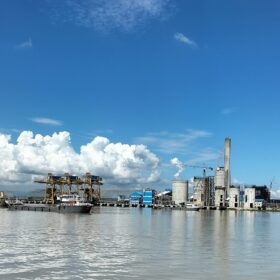
Bangladesh plans 442 MW solar facility near coal power plant
The Bangladesh Power Development Board plans to build a 442 MW solar plant near the Rampal Power Station with a $200 million investment, targeting the country’s largest installation and lower tariffs than comparable projects.

Switzerland deploys 1.52 GW of solar in 2025
Switzerland’s photovoltaic market slowed in 2025, with newly installed capacity falling 15% to 1,526 MW, according to Swissolar. Despite the decline, growth in residential storage, building electrification, and EV integration points to a gradual market recovery.

AI-enabled hacks expose remote shutdown risk in microinverters
IT security firm Jakkaru has identified a vulnerability in microinverters from AP Systems that could enable a “kill switch” scenario, potentially shutting down tens of thousands of inverters simultaneously and disrupting grid operations.

Greek utility completes 2.13 GW solar cluster at former coal mine
Greece’s PPC Group has finished construction of its 2.13 GW solar portfolio in northern Greece. The company is now working on its third large-scale battery storage facility in the area, with plans for two pumped-hydro storage projects also progressing.

Greece installs 1.9 GW of PV capacity in 2025
Greece installed around 1.9 GW of new solar capacity in 2025, bringing total installed solar capacity to roughly 11.5 GW, according to industry estimates.
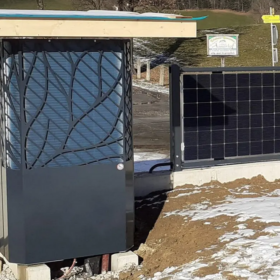
Austrian manufacturer offers modular air-to-water propane heat pumps
Lambda Wärmepumpen GmbH said its Eureka heat pump series uses a patented fluid mechanics system that reportedly improves heat transfer by four to six times while maintaining a temperature difference of just 3 K between the air and the refrigerant. Its seasonal coefficient of performance ranges from 4.50 to 6.10.
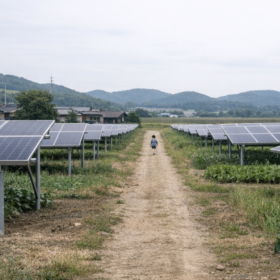
Croatia tenders 56 MW solar-storage project
Croatian power company Hrvatska Elektroprivreda is seeking a developer to build a 56 MW solar power plant tied to up to 200 MWh of battery energy storage. The deadline to submit expressions of interest is May 12.

GCL Optoelectronic targets 2026 IPO, US plant, space solar rollout
GCL Technology says its GCL Optoelectronic subsidiary plans a Hong Kong initial public offering (IPO) in 2026, alongside a potential 500 MW factory in the United States and a roadmap for space-based solar.
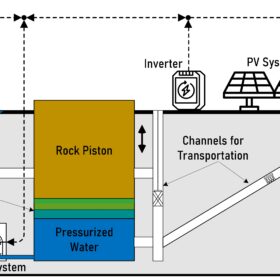
PV-driven hydraulic hydro storage may hit $0.022/kWh LCOE in the U.S.
An international study has demonstrated that utility-scale solar PV paired with hydraulic hydro storage (HHS) could reach an LCOE as low as $0.022/kWh in select U.S. regions. The system could provide GWh-scale, cost-competitive, and highly reliable long-duration storage, capable of powering large commercial districts with minimal environmental impact.
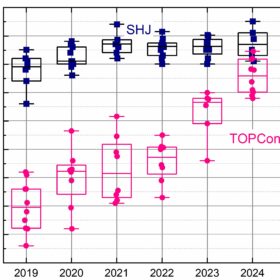
Heterojunction vs. TOPCon in perovskite-silicon tandem
Scientists in Australia claim that TOPCon cells are rapidly closing the open-circuit voltage gap with heterojunction counterparts, now under 10 mV, while offering greater wafer tolerance and high industrial scalability. Despite slightly lower efficiency, TOPCon-based perovskite/silicon tandems can achieve a levelized cost of energy comparable to heterojunction-based tandems due to reduced fabrication costs, according to the researchers.
