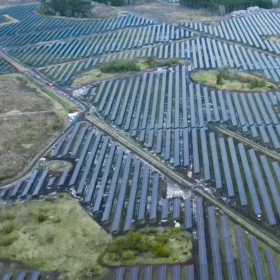
Alight inaugurates Sweden’s largest solar park
Swedish independent power producer Alight has completed a 64 MW solar project near Stockholm. The site in in Hallstavik is now the largest PV facility in the country.

Colombia approaches 2 GW solar capacity milestone
Colombia is approaching 2 GW of cumulative installed PV capacity, with 1.34 GW currently operational and an additional 700 MW in testing, according to the country’s grid operator.

Low residential solar feed-in tariffs can encourage battery deployment
Analysis of feed-in tariff scenarios in Central and Eastern Europe finds that while high feed-in tariffs are linked to the adoption of residential solar, lower tariffs are more likely to encourage battery installations. The study proposes a moderately low range of tariffs as one compromise to support both technologies.

Axpo, EDF Renewables Hellas sign 102 MW solar PPA in Greece
Axpo has signed a power purchase agreement (PPA) with EDF Renewables Hellas for two solar plants totaling 102 MW in Greece’s Viotia region.
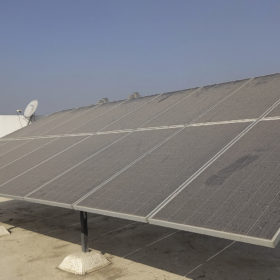
Preventing soiling with surface textured photovoltaic dummies
Scientists in South Africa have used computational fluid dynamics to investigate whether a dummy panel, placed in front of a working PV panel, can mitigate soiling. They have tested this setup with various inclination angles, heights, and distances and have found that the dummies accumulated up to 58% more dust than the PV panels.
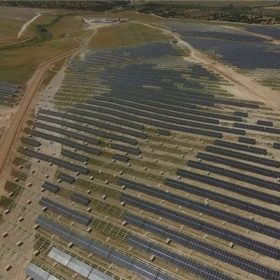
Spain hits 65.8 GW of solar projects with grid permits in March
Spain now has 65.8 GW of solar projects with grid-connection permits, says the country’s energy agency. Total renewable energy installations with grid permits hit 129.5 GW by the end of March, up 15.5% from February.
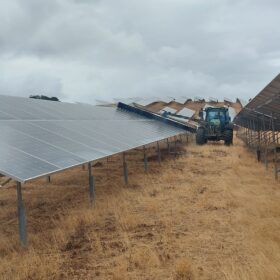
Chemitek Solar launches new antistatic soiling mitigation coating
The Portuguese company said its new anti-soiling solution lasts for at least a year. It can be applied during routine cleaning operations by mixing it directly in the cleaning water.
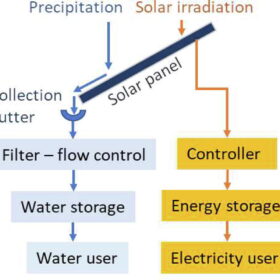
How to combine photovoltaics with rainwater harvesting
Scientists have developed a system that harvests rainwater running off PV panels for household use or hydrogen production. Their analysis showed that, in the southern Sahel, the system can meet both the energy and water requirements for electrolysis, with surplus rainwater covering up to 50% of a household’s daily water demand.

Germany allocates 2.63 GW in latest utility-scale PV tender
Germany’s latest auction for utility-scale solar concluded with prices ranging from €0.0399 ($0.0455)/kWh to €0.0488/kWh. The procurement exercise was significantly oversubscribed.

New web tool helps find best tilt angle for south-facing bifacial PV plants
An international research team has created a new model that finds the best tilt angle for south-facing bifacial PV plants across Europe. The scientists also considered the Alpine region to examine the impact of mountains on optimal tilt angles.
