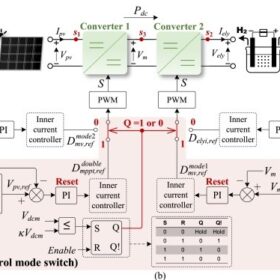
Low-power ride-through tech keeps green hydrogen flowing in standalone PV–electrolyzers
A UNSW-led research team proposed two low-power ride-through strategies for standalone PV–electrolyzer systems to maintain stability during sudden solar power fluctuations without using battery storage.

Installed BESS capacity in Spain grew by 589% since 2025 blackout
Some of the consequences of the blackout include a 589% increase in installed BESS capacity in Spain between April 2025 and April 2026, the introduction of renewable participation in voltage control, a greater role for gas in the generation mix, and continued progress on interconnections.

India launches 500 MW renewables tender requiring dispatch via power exchanges
Solar Energy Corporation of India has invited proposals to set up interstate transmission system (ISTS)-connected renewable energy projects for assured peak power supply of 1,500 MWh (500 MW for three hours) under a contract-for-difference (CfD) mechanism.
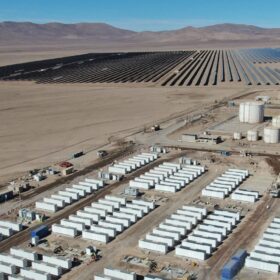
Sungrow proposes multi-microgrid clusters for mining above 100 MW
Sungrow has released a mining microgrid power solutions white paper in partnership with TÜV Rheinland and the China Electrotechnical Society covering application scenarios from 2.5 MW up to more than 100 MW.

The battery cost disconnect
For years, the battery energy storage (BESS) story has followed a familiar script: costs fall, deployment accelerates, economics improve. Even when cell costs rose and system prices briefly flattened during the 2021-22 lithium price spike, the narrative largely held. Paola Perez Peña, senior principal analyst at S&P Global Energy, examines why the latest jump in lithium prices has only had limited impacts on overall BESS costs so far.

China tightens carbon accountability framework, strengthening structural push for renewables
Beijing has introduced a stricter national carbon evaluation system that formally holds provincial governments accountable for emissions reduction and energy transition targets.

Cooling PV modules with hydrogel-coated paper
A Vietnamese research team has developed a low-cost passive cooling system for PV modules based on hydrogel-coated paper that combines water flow and interfacial evaporation to reduce operating temperatures. Outdoor tests showed temperature reductions of up to 14 C and efficiency gains of up to 16.8%, with stable operation achieved using both freshwater and natural seawater.
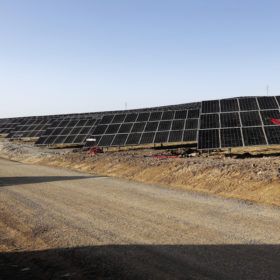
Cox buys Iberdrola Mexico for $4 billion
Cox has acquired Iberdrola México for $4 billion, adding 2,600 MW of capacity and becoming Mexico’s largest private power supplier with a 12 GW renewable project pipeline.

China commissions salt cavern hydrogen storage project
China’s first large-scale salt cavern hydrogen storage demonstration project has been commissioned in Henan province. The 1.5 million m³ facility validates geological hydrogen storage technology and supports renewable energy integration.
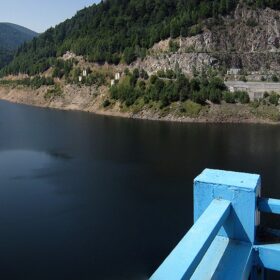
Bulgaria seeks to revive 864 MW Chaira pumped-storage hydropower plant
Supported by Toshiba, Bulgarian utility NEK is working to restart its 864 MW Chaira pumped-storage hydropower plant, the largest of its kind in Southeastern Europe. The facility has been offline since March 2022 following a turbine failure.
