
Fossils fuels to lead as Africa doubles its energy capacity this decade
Researchers led by Oxford University have put together a comprehensive forecast of energy developments across the African continent up to 2030. Based on analysis of data on more than 3,000 power plant projects across 54 countries, the report predicts a doubling of generation capacity in Africa over the next decade, with fossil fuel projects to represent 60% of the total. Based on this, the authors warn of the need for both the public and private sectors to change to tack to avoid a missed opportunity for renewable energy.
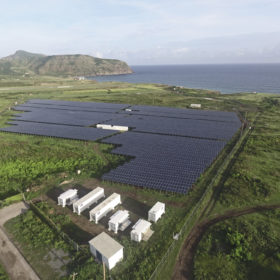
New method to build microgrids based on solar, hydrogen
The use of polymer electrolyte membrane fuel cells as backup power generation in solar microgrids could drive down costs and improve efficiency, according to an international group of researchers. They have proposed a new energy management system that could be ideal for hybrid solar-hydrogen microgrids in remote locations.

Australian industrial precinct to host 28 MW/56 MWh grid-balancing battery
The battery will serve the industrial precinct of Newcastle in the Australian state of New South Wales. It will not be directly linked to solar or wind generation but will be intended to charge and discharge directly from the grid in response to disturbances or market signals.
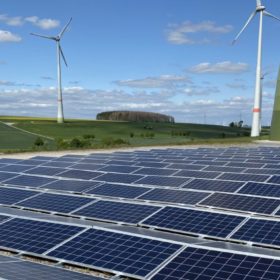
New mounting system to integrate small PV into wind farms
Switzerland’s Smartvolt has developed a special mounting system that facilitates the quick deployment of small ground-mounted PV systems at the base of wind turbines.
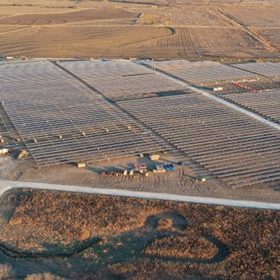
Innovative PPA debuts in US solar sector
Proxy generation power purchase agreements, which were first used with wind projects, manage weather-related risks by settling energy transfers based on a proxy generation index, rather than on actual metered generation. Operational risk shifts from buyer to seller.

Hard carbon for a high energy sodium battery
Scientists in Japan demonstrated a hard-carbon electrode that can greatly increase the capacity of a sodium-ion battery. With further work on the long-term performance, the discovery could make sodium-ion batteries better able to compete on energy density with their lithium-ion counterparts.
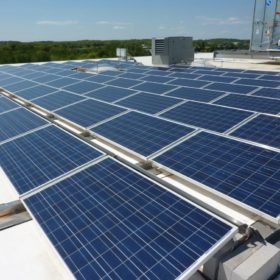
Belgium deployed 900 MW of PV in 2020
Renewable energy production increased by 31% and now represents 18.6% of the country’s electricity mix. Its cumulative PV capacity increased from 3,887 MW at the end of 2019 to 4,788 MW at the end of December.
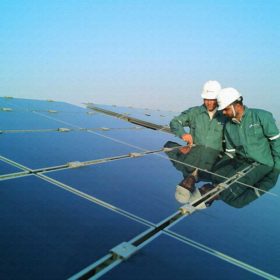
Sembcorp wins 400 MW solar project in Indian auction
With its latest victory, Sembcorp Industries has expanded its renewables portfolio to more than 3 GW across Singapore, China, and India.
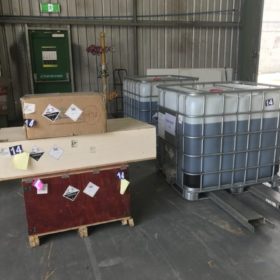
Australian Vanadium pushes ahead with plans for residential flow battery
Australian Vanadium is pushing ahead with plans to develop a vanadium redox flow battery for the Australian residential market, via its VSUN Energy subsidiary.

South Korea opens its renewable energy market to PPAs
Power purchase agreements will be allowed between renewable energy producers owning plants with a capacity of more than 1 MW and electricity consumers. Local utility Kepco, however, will keep serving as an intermediary.
