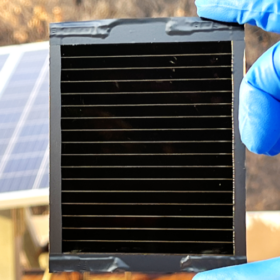
Chinese researchers build 21.60%-efficient perovskite solar modules via blade coating
A research team led by the Dalian Institute of Chemical Physics in China have used tetramethylammonium chloride in the fabrication of perovskite solar cells and modules, demonstrating that it improved both stability and efficiency results. The group’s 10 cm × 8 cm modules achieved certified 21.60% power conversion efficiency. The novel interfacial modification enabled the use of scalable blade coating to deposit both transport layers and the perovskite layer.
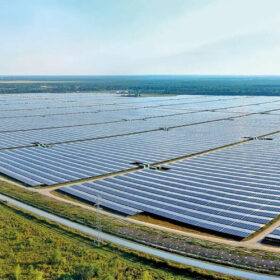
A closer look at France’s largest solar plant
Neoen’s 300 MW Cestas solar park, commissioned in 2015, remains France’s biggest PV plant and the only one in the country that contributes to grid stability, even at night.
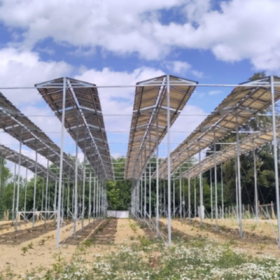
Fraunhofer ISE estimates Germany’s agrivoltaic potential at 500 GW
Fraunhofer Institute for Solar Energy Systems (ISE) says Germany could deploy up to 500 GW of agrivoltaic capacity, based on a nationwide assessment of all agricultural land types and site suitability criteria.
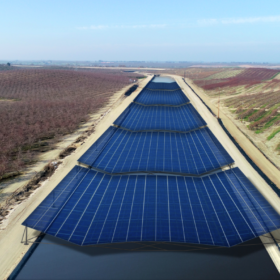
The best tilt angle for canal-mounted PV systems
Researchers in Türkiye have conducted an experimental study on the ideal tilt angles for PV systems deployed on canals. Their analysis showed that an 8◦ tilt angle consistently demonstrates greater performance.

NREL develops translucent solar panels for bigger, better crops
Researchers at the National Renewable Energy Laboratory grew tomatoes under translucent solar panels, which could play a promising role in agrivoltaics.
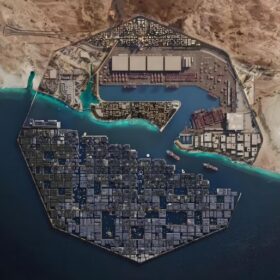
‘Grid-forming technology is no longer experimental – it’s here and working’
In grids increasingly dominated by renewables, grid-forming technology is emerging as critical tool for maintaining stability and ensuring reliable power system operation. In this interview with ESS News, Rui Sun, Sungrow’s Deputy General Manager-Grid Technology Center, explains how grid-forming works, why it matters, and where the technology is already proving its value. He elaborates on technical challenges, regulatory gaps, and why grid-forming could soon become the new industry standard.

Italy launches floating PV tender
The Italian authorities have opened a tender to support the deployment of about 50 MW of floating PV capacity.
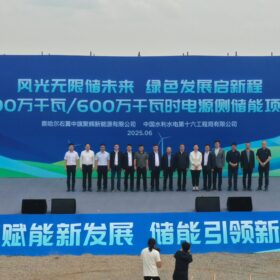
PowerChina breaks ground on world’s largest power generation-side battery storage project
On June 26, the construction of the world’s largest power generation-side energy storage project in Ulan Chab, Inner Mongolia, officially began. This 1 GW/6 GWh project, using lithium iron phosphate (LFP) technology, aims to enhance grid stability and support China’s renewable energy transition.

Researchers identify optimal level of solar, battery storage for European energy market
Researchers in Hungary have developed a model to calculate the optimal PV and battery storage balance to support the European grid in the next few years. They found that the cost-optimal range is at 530–880 GW of PV, combined with battery storage equivalent to 2.5–7.5% of the total intermittent capacity.

World’s largest vanadium flow battery goes online in China
A giant solar-plus-vanadium flow battery project in Xinjiang has completed construction, marking a milestone in China’s pursuit of long-duration, utility-scale energy storage.
