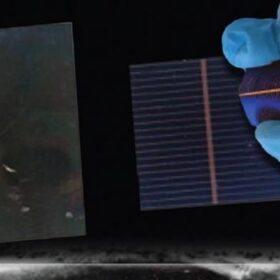
Researchers build 20-μm-thin monocrystalline solar cell with 21.1% efficiency
The scientists built the device by depositing multiple metal nanofilms on both sides using plasma-enhanced chemical vapor deposition. The cell achieved an open-circuit voltage of 684 mV, a short-circuit current density of 38.2 mA/cm2 and a fill factor of 80.8%.
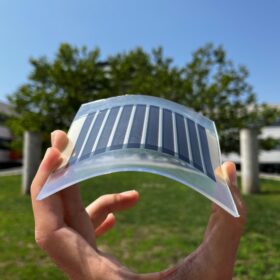
European research group creates injection molding plastic solar cells
A French-Spanish research team developed organic photovoltaic modules embedded into plastic parts through high throughput injection molding. The researchers injected thermoplastic polyurethane in the modules and found it enhances their mechanical stability while keeping a high flexibility.
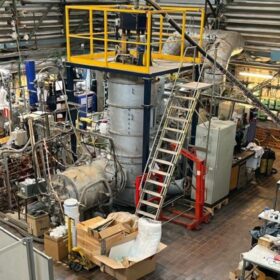
Swedish startup to use green hydrogen plasma in pilot reactor for solar grade silicon
Encouraged by lab results and a feasibility study, Swedish startup, Green14, in collaboration with Sweden’s Royal Institute of Technology (KTH) plans to build a pilot-scale reactor to make solar grade silicon with a hydrogen plasma process. The company sees the pilot as a step towards using a more sustainable method to produce solar grade silicon for the PV industry at its own gigawatt-scale plant.

SolarPower Europe to support European PV without trade barriers
SolarPower Europe’s board members have issued a joint statement calling for three measures to safeguard the European solar industry, as they claim that tariffs and trade barriers are not viable solutions.
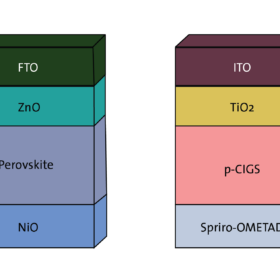
Novel perovskite/CIGS tandem PV cell design promises 38.39% efficiency
A research team in Bangladesh has simulated a perovskite-CIGS PV device that can reportedly achieve a remarkable tandem cell voltage of 2.48 V. The proposed method is also applicable for tandem cells composed of other materials.
Australian solar market hit by declining global panel prices
Tongwei Solar’s entry into the Australian solar market has triggered disruption in recent months, amplified by the ongoing global decline in panel prices, which solar analyst Warwick Johnston says has yet to fully affect the country.
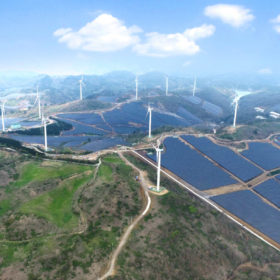
South Korean regional governments bypass minimum distance guidelines to allow solar PV
Jaebin Choe, renewables permitting team researcher at environmental advocacy organization Solutions for our Climate (SFOC), told pv magazine that some South Korean regional governments have been forced to pass exceptional clauses to allow the construction of solar PV arrays in their municipalities despite federal recommendations. The association claims this represents the ‘biggest bottleneck’ in the country’s solar pursual.

Chinese PV Industry Brief: BAJsolar commissions 10 GW solar cell factory
BAJsolar has finished building a 10 GW solar cell factory in eastern China. It has invested CNY 2.6 billion ($355.75 million) in the new facility.

Sliding solar module prices squeezing European manufacturers
Plummeting module prices are weighing on European manufacturers, but the impact on wholesalers is differently, as warehouse conditions are showing signs of improvement.

Wind speed increases could cause PV yield losses
A Spanish research group says air flux variations over different parts of solar plants could also lead to mismatch losses. Past. studies have only looked at the benefits of high wind speed on PV arrays, which enhances module cooling.
