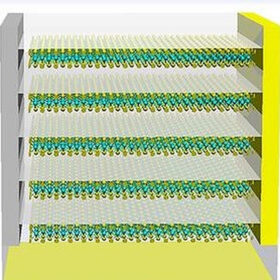
2D solar cell design based on transition metal dichalcogenides promises 12.87% efficiency
US researchers have designed a 2D solar cell based on TMDCs that may exceed by far the efficiency of this device typology, which usually doesn’t exceed 6%. The novelty of this cell consists of its superlattice structure, which the research group said can separate the layers of 2D TMDCs by a spacer, thus improving light absorption.
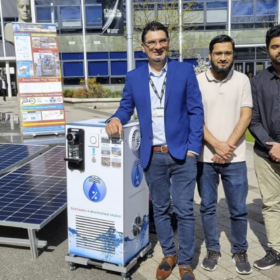
New portable system uses PV to produce drinkable water from air moisture
UK scientists have developed Solar2Water, a system that generates twice the amount of water as conventional atmospheric water generators. The system operates efficiently with the same energy input, regardless of air humidity, relying solely on photovoltaics.

IBC solar cell based on ultrathin black silicon wafer achieves 16.4% efficiency
A Spanish-Finnish research team has fabricated an IBC solar cell with an ultrathin black silicon wafer with a thickness of 40 µm. The device is based on vanadium oxide and laser-processed phosphorus-doped silicon carbide stacks as hole and electron transport layers, respectively.

German PV equipment securing orders from US, European markets
German engineering federation VDMA has published a new report outlining strong demand for solar production equipment from non-Asian markets, indicating a shift in the global solar industry landscape.

Chinese PV Industry Brief: TW Solar plans 20 GW module factory in Sichuan province
TW Solar announced it will invest around $1.48 billion in a new integrated solar module manufacturing facility in Chengdu City. Meanwhile, Jinkosolar began to buy new production equipment for its expansion plans from Wuxi Autowell.

Singulus claims new coating machine can improve PV cell efficiency up to 1%
Singulus says its new production equipment can apply a passivation layer to the edges of half-cell, multi-cell, and shingle cells. Its Generis PET machine is also suitable for batch or inline processing and is compatible with all crystalline solar cell technologies.
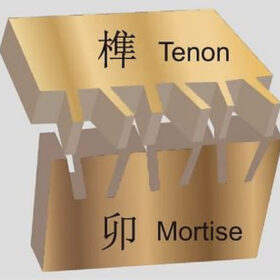
Perovskite solar cell based on Mortise-Tenon tech achieves 24.55% efficiency
Chinese researchers have used Mortise-Tenon technology to connect the perovskite absorber with the hole transport layer in a perovskite solar cell. They say that this reduces non-radiative recombination, while improving the cell’s open-circuit voltage and fill factor.
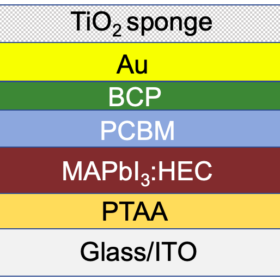
Semitransparent perovskite solar cell with 11.6% efficiency
Italian scientists have used a titanium oxide sponge to successfully prevent lead leakage in a semitransparent solar cell. The device has demonstrated comparable efficiency to semi-transparent perovskite devices and has an average visible transmittance (AVT) of 31.4%.
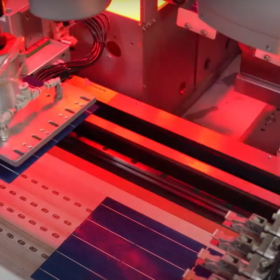
Waaree signs 10 GW solar module line deal with Jinchen
Waaree, India’s largest solar module manufacturer, has placed an order with Jinchen for a 10 GW production line.
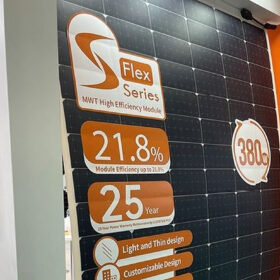
Weekend Read: Flex generation
A new generation of flexible, lightweight modules is entering the market. With back contact technology offering its own form of design flexibility and robustness, the new products could crack a hard-to-address market segment.
