
The case for microinverters in Indian rooftop solar
Sunil Thamaran, India head for US company Enphase Energy, explains why microinverters are a good investment for rooftop solar. He also talks about the trends in microinverter design and the company’s plans in India.
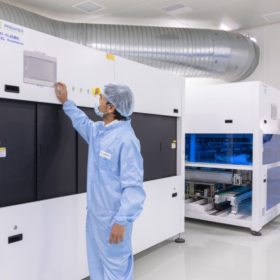
Premier Energies starts production at new Indian solar factory
The solar manufacturer has started trial production of high-efficiency solar cells at its new site in the southern state of Telangana. The fab can produce 19.2%-efficient multi-crystalline cells using MCCE textured black silicon, as well as making 22.5%-efficient mono PERC products.

Namibia’s capital city seeks proposals for 25 MW of PV
Through the tender, the administration of Windhoek wants to build several projects on a build, own, and operate basis.
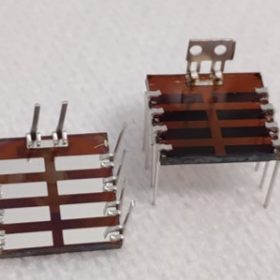
Black perovskite solar cell with 15% efficiency via thermal evaporation
The cell exhibited an open-circuit voltage of 1.1 V and was able to retain around 90% of its initial performance after 215 days of exposure to dim light at room temperature. According to its creators, this performance and the notable stability were ensured by the thermal evaporation technique used for depositing the perovskite layers onto the cell.
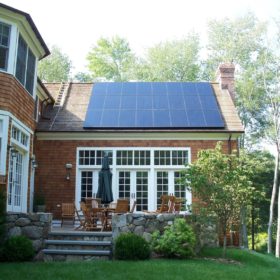
Solar 101: It all comes down to curb appeal
The residential solar industry has taken notice of the demand for beautiful, hidden panels, and is now providing creative and attractive designs that you can incorporate into your rooftop solar project.

Chinese PV Industry Brief: 50 GW wafer factory commissioned in Qinghai province
Furthermore, Zhonghuan Semiconductor has slightly reduced its wafer prices, while Longi has maintained them unchanged. Flat Glass is raising funds to support the construction of a new glass factory with a total annual capacity of 750,000 metric tons.
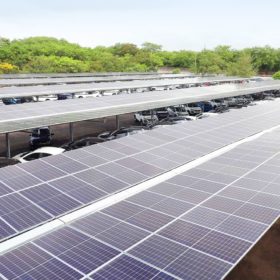
India’s largest solar carport comes online
The 6.2 MWp solar carport at Tata Motors’ manufacturing facility in Maharashtra spans over 30,000 square meters.

Lightsource BP buys 703 MW of PV projects in Spain, seeks off-takers through tender
The U.K.-based solar developer wants to identify potential buyers for the electricity generated by the facilities through competitive bidding.

Flexible perovskite solar module with 10.5% efficiency
The methylammonium-free inverted solar module was built on a flexible substrate made of polyethylene terephthalate (PET). A hole transporting material made of poly(triarylamine) (PTAA) and a double-cation cesium formamidinium (CsFA) perovskite layer were deposited through blade-coating and nitrogen-assisted blade-coating.

Austria deployed 341 of new PV in 2020
The country’s cumulative PV capacity exceeded 2 GW at the end of 2020.
