
Women reshaping leadership narrative through collective reframing of power and presence
This week, during Intersolar 2025, Women in Solar+ Europe hosted a powerful workshop titled Women Reshaping the Leadership Narrative. Women leaders and experts from across the sector gathered to challenge outdated stereotypes and redefine authentic, inclusive leadership. From embracing vulnerability and rejecting the “too” labels often placed on women, to reframing feedback and leading without apology, participants explored how to turn long-held biases into strengths. The session fostered open dialogue, intergenerational insight, and a shared commitment to modelling change, leaving attendees inspired to keep reshaping leadership on their own terms.
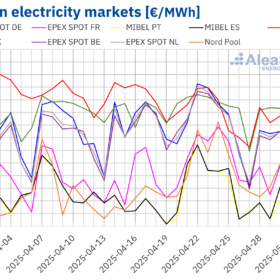
France, Italy set daily solar generation records
AleaSoft Energy Forecasting says increases in solar energy production contributed to lower electricity prices across major European markets last week. Most analyzed markets also continued to experience negative hourly prices.
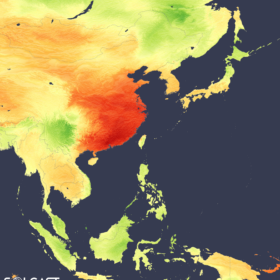
China’s year-to-date irradiance up 30% as aerosols drop
In another weekly update for pv magazine, Solcast, a DNV company, reports that a significant reduction in airborne pollutants has contributed to year-to-date irradiance in some parts of China being up to 30% higher than the long-term average. South Korea has benefited from a similar pattern, recording a 10% increase in irradiance from January to April relative to its long-term average.

Eturnity adds more PV design automation, energy system project control to its software
Additional project management and design automation tools are available on the Swiss software company’s subscription-based platform made for small and medium-sized (SME) businesses that are targeting commercial and industrial (C&I) and residential the solar PV segments.

Cow poop (and more) on the floor at Intersolar
Cow dung battery binder, a beautiful electric moped, parking lot level car charging, big rig charging, and “balcony solar” energy storage on the floor at Europe’s largest solar power show.

FuturaSun, TNO sign bifacial solar cell collaboration
FuturaSun and The Netherlands Organization for Applied Scientific Research will work together on advancing the design of bifacial n-type silicon solar cells, with the technology to be integrated into FuturaSun’s Silk Nova solar modules.

TCL SunPower launches back contact solar modules
The SunPower M Class product portfolio offers solar panels for the residential and commercial markets featuring the company’s latest back contact solar technology. The panels are expected to reach 25% efficiency for residential applications up to 500 W and 24.4% for commercial applications up to 660 W.
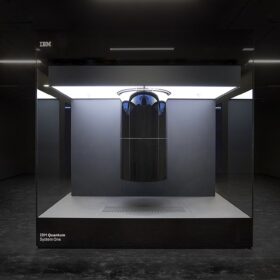
Quantum-based energy management method for PV-powered buildings
Scientists from Cornell University combined quantum computing with model predictive control to manage the energy of two PV-equipped university buildings. Compared to deterministic approaches, the quantum strategy achieved a 6.8% improvement in energy efficiency and an annual reduction of 41.2% in carbon emissions.
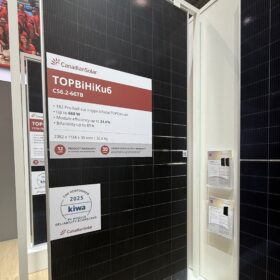
Canadian Solar debuts 660 W TOPCon solar panel with 24.4% efficiency
The new products are available in seven versions with power output ranging from 630 W to 660 W and power conversion efficiency spanning from 23.3% to 24.4%.
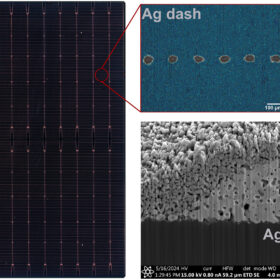
Silver-lean screen-printing can reduce silver use in TOPCon solar cells by 40%
An international research team has developed a metallization technique for TOPCon solar cells that can reportedly reduce silver usage in the devices’ rear side by 85%. The scientists replaced the commonly used Ag fingers with intermittent Ag dashes for contact formation and Ag-free fingers and busbars for electrical conduction.
