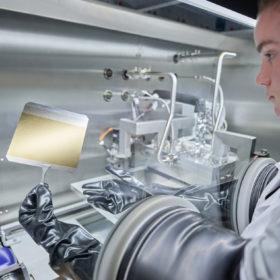
Atomic layer deposition tool for perovskite cell pilot line
Dutch equipment supplier SALD has announced delivery of a spatial atomic layer deposition system to an unnamed customer in the United States. The tool will be used in the pilot-scale production of perovskite solar cells. While it has not disclosed the exact function of the tool within the pilot project, it said it will be used to deposit thin coatings to protect cells from damage in later manufacturing stages, and ensure their longer-term stability.
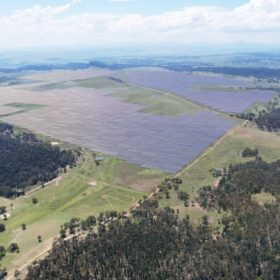
Maoneng reveals plans for 950 MW solar-battery project in Australia
Maoneng has unveiled ambitious plans to build a giant solar farm and battery energy storage facility in Australia.

Shell to acquire Indian solar developer for $1.55 billion
Shell has signed an agreement to acquire Solenergi Power, an Actis company that owns 100% of Indian developer Sprng Energy. The transaction, valued at $1.55 billion, is expected to close later this year.

Elon Musk wins SolarCity lawsuit, avoids $2 billion judgment
Business magnate Elon Musk has avoided what would have been the largest judgment in US history on an individual executive.
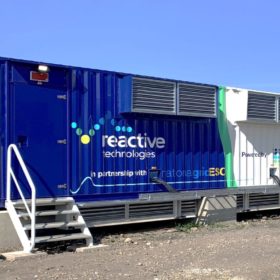
Ultracapacitor sonar seeking grid with 100% solar, wind
Reactive Technologies uses an ultracapacitor to send signals to the grid that help managers determine the level of system inertia, supporting power grid stability – and they’re coming to the United States.

Chinese PV Industry Brief: Longi, Zhonghuan raise wafer prices
A Chinese industry group has reported rising polysilicon prices and supply chain problems ahead, but GCL Technology said this week that strong polysilicon and wafer prices were the reason its business performed strongly in 2021.
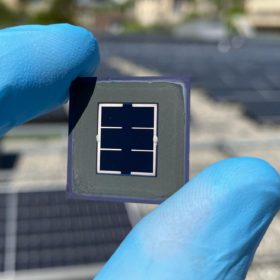
EPFL achieves 29.2% efficiency for tandem solar cell with fully textured silicon
Scientists in Switzerland made significant progress with an approach to perovskite-silicon tandem cell design that they say could eventually be integrated into existing silicon PV manufacturing. They have announced the achievement of a 29.2% cell efficiency – not far from the overall record for tandem cells, and verified by Germany’s Fraunhofer ISE.
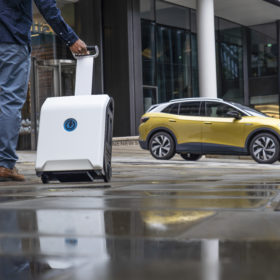
The mobility rEVolution: Portable EV charging stations for personal and shared use
In other news, BYD’s quarterly profit is up by 241% buoyed by demand for battery-powered cars, Ford takes a US$3.1 billion loss on its Rivian stake and cuts 580 jobs as part of corporate restructuring, and ABB agrees to provide its full portfolio of EV charging technology to Shell.
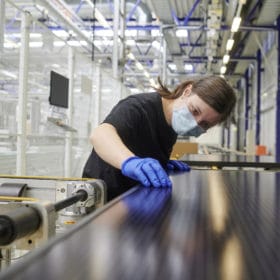
Meyer Burger to increase module, cell capacity in Germany
Swiss PV module manufacturer Meyer Burger has decided to achieve its capacity expansion targets by focusing on its German factories, in reaction to ongoing global logistics problems and supply chain issues.
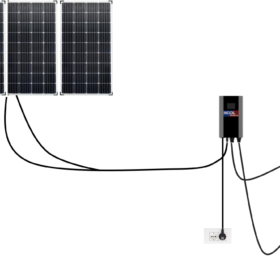
New PV water heater from Germany
German startup Nexol has developed a photovoltaic water heating system that relies on a smart controller, with either DC and AC power. It decides autonomously if grid electricity or PV is used, with the latter always preferred.
