





Taiwan’s Ministry of Economic Affairs (MOEA) has announced its feed-in tariff (FiT) rates for the country's 2026 fiscal year.
FiTs for solar remain unchanged from the second half of 2025. The highest available solar tariff stands at TWD 5.63 ($0.18)/kWh, for rooftop solar between 1 kW and 10 kW in capacity. Rates decline as installation size increases, with an array over 500 kW receiving a FiT of TWD 3.89/kWh.
Ground-mounted solar installations above 1 kW can benefit from a FiT of TWD 3.50/kWh, while floating solar above 1 kW receives a TWD 3.89/kWh tariff.
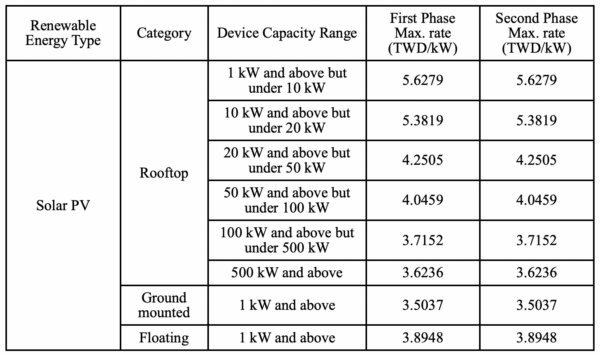
Image: Ministry of Economic Affairs
MOEA decided to maintain the same solar tariff rate in 2026 in order to maintain current momentum in deployment, according to reports from Taiwan’s Environmental Center. It adds the maintained rate should help projects that are facing uncertainties due to increased environmental and resilience requirements.
Taiwan’s feed-in tariff system, first implemented in 2010, ensures a 20-year purchase agreement for renewable energy. It has been a key driver of the country’s rooftop solar market but rates have slowly declined over the years. At the start of last year, FiTs for rooftop PV began at TWD 5.70/kWh, before moving to the current rate half way through the year.
MOEA is also introducing a repowering mechanism designed to encourage replacement of aging equipment with higher-efficiency products and increase solar generation within an existing space. While the mechanism is yet to be legally formalized, proposals made by the ministry last year suggested a repowered plant could effectively be treated as two separate installations, with existing capacity maintaining its current rate and the new capacity subject to a new 20-year tariff.
In December, UK-based consultancy GlobalData said Taiwan is on course to more than double its current solar capacity by 2035. Last November, the country tightened its rules governing ground-mounted and floating solar, after the Ministry of Environment announced plans to update environmental impact assessments standards for solar projects amidst growing public concern.
This content is protected by copyright and may not be reused. If you want to cooperate with us and would like to reuse some of our content, please contact: editors@pv-magazine.com.



By submitting this form you agree to pv magazine using your data for the purposes of publishing your comment.
Your personal data will only be disclosed or otherwise transmitted to third parties for the purposes of spam filtering or if this is necessary for technical maintenance of the website. Any other transfer to third parties will not take place unless this is justified on the basis of applicable data protection regulations or if pv magazine is legally obliged to do so.
You may revoke this consent at any time with effect for the future, in which case your personal data will be deleted immediately. Otherwise, your data will be deleted if pv magazine has processed your request or the purpose of data storage is fulfilled.
Further information on data privacy can be found in our Data Protection Policy.