





Saudi Arabia installed around 7.8 GW of solar last year, according to analysis from UK-based consultancy GlobalData.
GlobalData says Saudi Arabia’s cumulative solar capacity increased from 4,665 MW at the end of 2024 to an estimated 12,465 MW by the end of last year. The growth is the largest in a calendar year in Saudi Arabia to date and with the country’s total renewables capacity standing at around 13 GW, makes solar the dominant form of renewables in the country.
Looking ahead, GlobalData is expecting around 5.2 GW of solar to be added this year, and 9.6 GW to be added in 2027, taking cumulative capacity to 27.3 GW by the end of next year.
The consultancy then forecasts annual solar additions between 12 GW and 14 GW for the years 2028 to 2035, which would take Saudi Arabia’s cumulative solar capacity past 50 GW in 2029 to 67.2 GW by the end of the decade. This trajectory would see the 100 GW threshold surpassed in 2033, growing to 129.7 GW by 2035.
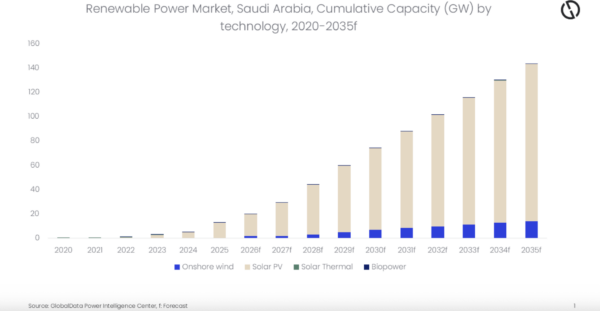
Image: GlobalData
GlobalData’s analysis notes that this growth trajectory falls behind the pace required to reach a target of 130 GW of renewable power capacity by 2030, as set in the most recent version of the Saudi Arabia Vision 2030. To reach the target, the country would need to add over 23 GW of renewables annually.
Attaurrahman Ojindaram Saibasan, Power Analyst at GlobalData, told pv magazine that to in order to increase its forecast solar additions, Saudi Arabia should publish a credible five-to-ten year solar build-out pipeline with standardized, bankable power purchase agreements (PPAs) and regular auctions, backed by strict delivery milestones to prevent delays.
“In parallel, it should speed project execution by streamlining permitting and land access through a one-stop process, pre-developing solar zones, and making interconnection transparent with clear queues, timelines, and published grid hosting capacity,” Saibasan added.
Saibasan also explained that Saudi Arabia needs major grid and flexibility investments to absorb much more solar, highlighting the need for new transmission to resource areas, better forecasting and grid codes for inverter-based resources, and large-scale PV-plus-storage procurement to cover evening peaks and limit curtailment.
“It should also expand distributed solar via simple net billing/wheeling for businesses, mobilize low-cost finance such as green bonds/sukuk guarantees, build cost-effective local supply chains and workforce, and adopt desert-optimized O&M standards,” Saibasan said.
Growth in Saudi Arabia’s solar market is led by gigawatt-sized utility-scale projects. Among the projects to come online last year were three belonging to Riyadh-based developer ACWA Power totaling 2.79 GW of new operational capacity.
The sixth phase of Saudi Arabia’s national renewable energy program concluded last year, awarding 3 GW of solar, including a project that was won at the second-lowest levelized cost of electricity for solar energy in history. The seventh round has already kicked off, covering 3.1 GW across four solar projects.
Last year also saw the Saudi Power Procurement Company sign five solar PPAs totaling 12 GW and two wind PPAs totaling 3 GW, together billed as the largest renewable energy capacity signed for in a single phase globally to date. The projects are scheduled to be operational across 2027 and 2028.
Saibasan added that that in the coming years, the main drivers of Saudi Arabia’s solar market are likely to shift towards grid integration and flexibility, bringing faster interconnection and a focus on large-scale solar-plus-storage.
“Additional pull should come from electricity-demand growth and electrification, a larger role for private/C&I solar and corporate PPAs as regulations mature and potentially export-linked decarbonization, via green hydrogen and green industrial products supported by improved permitting and financing tools,” Saibasan told pv magazine.
Last month, research from Saudi Arabia's King Abdullah Petroleum Studies and Research Center outlined pathways for the country to reach net-zero power sector emissions by 2060, calculating that deploying 151.3 GW of solar would cover only 0.16% of the country.
This content is protected by copyright and may not be reused. If you want to cooperate with us and would like to reuse some of our content, please contact: editors@pv-magazine.com.


By submitting this form you agree to pv magazine using your data for the purposes of publishing your comment.
Your personal data will only be disclosed or otherwise transmitted to third parties for the purposes of spam filtering or if this is necessary for technical maintenance of the website. Any other transfer to third parties will not take place unless this is justified on the basis of applicable data protection regulations or if pv magazine is legally obliged to do so.
You may revoke this consent at any time with effect for the future, in which case your personal data will be deleted immediately. Otherwise, your data will be deleted if pv magazine has processed your request or the purpose of data storage is fulfilled.
Further information on data privacy can be found in our Data Protection Policy.