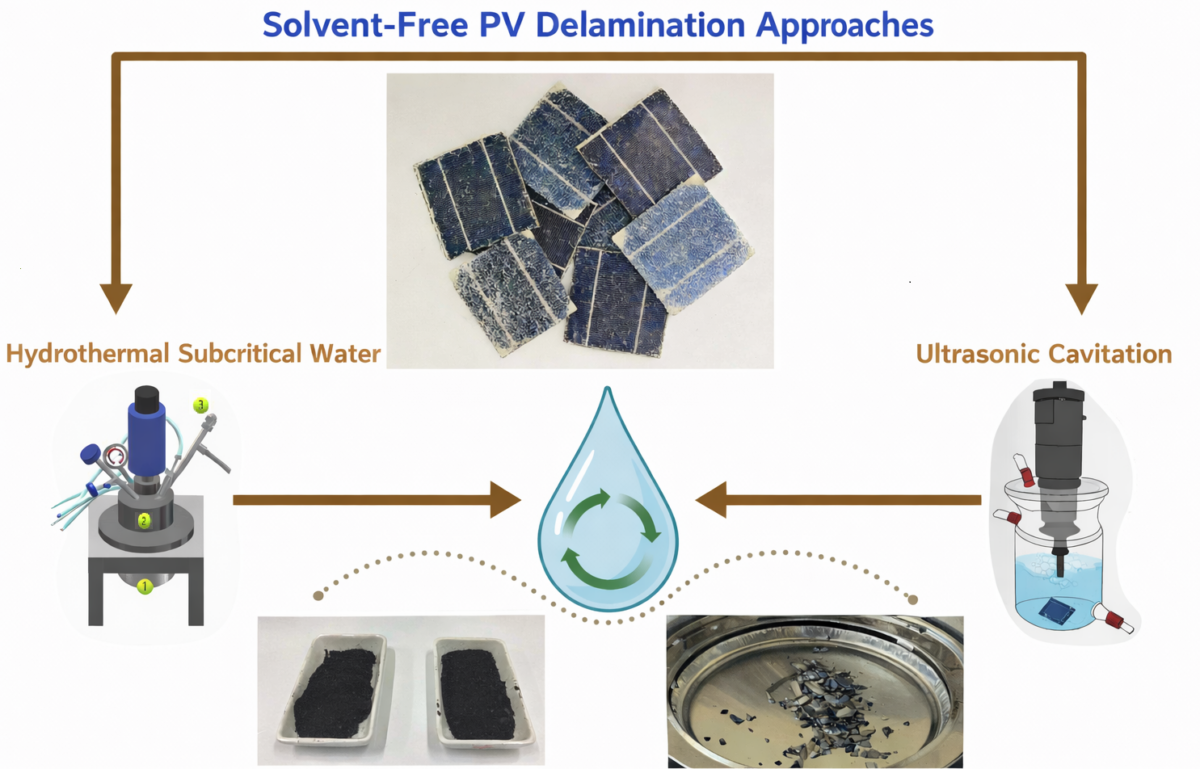





Researchers from Germany’s Fraunhofer Institute for Ceramic Technologies and Systems (IKTS) and Turkey’s Ege University have developed a novel approach for end-of-life crystalline-silicon (c-Si) photovoltaic modules delamination that uses ultrasonic cavitation to fully separate the glass and the front ethylene vinyl acetate (EVA) layer, and partially release c-Si fragments from the back EVA layer.
Ultrasonic cavitation occurs when high-frequency sound waves pass through a liquid, creating tiny bubbles that rapidly form and collapse. This collapse releases intense local pressure and heat, producing powerful mechanical and chemical effects. It can generate shockwaves, microjets, and localized heating, which can break apart solids or remove contaminants. Ultrasonic cavitation is widely used for cleaning delicate items, promoting chemical reactions, and improving emulsification or nanoparticle dispersion. Essentially, it harnesses imploding bubbles to create strong microscopic forces for cleaning, mixing, or material processing.
“This study introduces ultrasonic cavitation as an alternative solvent-free delamination mechanism,” corresponding author Aslı Birtürk told pv magazine. “It is the second method in a series of eco-friendly, solvent-free PV delamination approaches developed during my doctoral studies under the supervision of Prof. Melih Soner Celiktas. The first method, developed in 2024, achieved a mass-based delamination efficiency of 98.4% using only distilled water without any chemical solvents.”
Birtürk added that both studies are proof-of-concept process evaluations that explore sustainable delamination strategies for end-of-life PV modules. “There is potential to explore further scaling up these proof-of-concept methods from laboratory to pilot scale, considering life cycle assessment (LCA), optimizing operational parameters for industrial applicability, and improving recovery rates for critical raw materials (CRMs),” she added.
In their most recent research, the scientists began by preparing small c-Si PV module pieces measuring 2.5 cm × 2.5 cm and weighing 25 g. They were placed in a jacketed glass reactor containing 100 ml of distilled water, set to 85 C. Ultrasonic cavitation was initiated using an ultrasonic probe at 20 kHz and 50% amplitude. The samples were exposed to ultrasonic cavitation for 20, 40, and 60 h, with intermediary checks occurring at the end of each hour.
In addition, the group has used computational fluid dynamics (CFD) to understand how cavitation physically interacts with materials. They further used scanning electron microscopy (SEM), energy-dispersive X-ray spectroscopy (EDX), and Fourier transform infrared spectroscopy for material characterization. LCA was conducted to evaluate the environmental impact of the process.
“One notable finding was that delamination could be achieved without any chemical additives, driven primarily by mechanical effects,” said Birtürk. “The significant role of EVA deformation and the associated emission benefits were particularly encouraging outcomes. It’s both a surprise and not, but we demonstrated the chemical-free delamination effect in two separate articles.”
The researcher added that “using this method, a mass-based delamination efficiency of 82.2% was obtained. The process works by mechanically weakening the interfacial EVA layer, and the experimental results show that the deformation behavior of EVA plays a dominant role in the clean separation. The life cycle assessment indicates a net emission benefit of -5.75 kg CO₂ equivalent, highlighting the environmental potential of this approach.”
Their findings were presented in “Solvent-free ultrasonic approach for delamination of end-of-life crystalline-silicon PV modules,” published in Sustainable Materials and Technologies.
This content is protected by copyright and may not be reused. If you want to cooperate with us and would like to reuse some of our content, please contact: editors@pv-magazine.com.


By submitting this form you agree to pv magazine using your data for the purposes of publishing your comment.
Your personal data will only be disclosed or otherwise transmitted to third parties for the purposes of spam filtering or if this is necessary for technical maintenance of the website. Any other transfer to third parties will not take place unless this is justified on the basis of applicable data protection regulations or if pv magazine is legally obliged to do so.
You may revoke this consent at any time with effect for the future, in which case your personal data will be deleted immediately. Otherwise, your data will be deleted if pv magazine has processed your request or the purpose of data storage is fulfilled.
Further information on data privacy can be found in our Data Protection Policy.