




A research team led by scientists from Slovakia’s Constantine the Philosopher University in Nitra has developed a new predictive and anomaly-detection model for PV inverters in commercial installations. The novel machine-learning-based framework uses temporal and electrical data alone, without relying on environmental sensors.
“The chosen algorithms, Random Forests for prediction and Z-score analysis for anomaly detection, were selected for their robustness, interpretability, and suitability for small yet high-frequency datasets, making them well-aligned with practical PV monitoring deployments,” the academics said. “Furthermore, the absence of irradiance or temperature data is explicitly addressed by constructing time-based proxies (hour, day, and weekday patterns) to capture cyclical solar generation behavior.”
The model uses real-world operational data from a grid-connected PV plant in western Slovakia, including two inverters with rated capacities of 30 kW and 40 kW. Inverter, grid power, and grid voltage data were collected at five-minute resolution from Jan. 1 to Feb. 1, 2025, using inverter and grid monitoring sensors.
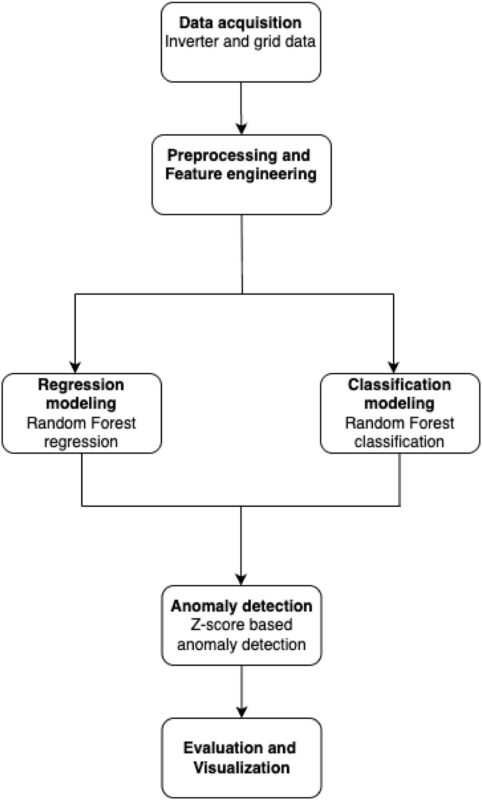
Image: Constantine the Philosopher University in Nitra, Results in Engineering, CC BY 4.0
To enable machine learning analysis, preprocessing was required. Subsequently, a Random Forest Regressor was trained to predict the actual inverter power output (kW) at each five-minute step. Subsequently, a Random Forest Classifier was used to map continuous power to operational states, namely low, medium, and high. It could classify the current state as well as a future state, one hour ahead. Finally, a Z-score Analysis was used to quantify the extent to which the actual power deviates from the predicted power. Values that exceeded a statistical threshold were flagged as anomalies.
“A Random Forest Regressor achieved high fidelity in power prediction (R² = 0.995, mean absolute error = 0.12 kW), while classification models categorized output levels with 100% accuracy under static conditions,” the results showed. “Anomaly detection using Z-score analysis identified significant outliers, particularly during high-production intervals. However, one-hour-ahead classification revealed substantial drops in predictive performance (accuracy = 36.4%), highlighting the inherent difficulty of forecasting under variable environmental conditions.”
Concluding, the research team added that “unlike other recent work, which integrates meteorological and contextual data for multi-level diagnosis, the proposed model operates solely on inverter and grid-side electrical measurements. This distinction highlights the practical value of the presented approach in scenarios lacking environmental sensors, offering a transparent and computationally efficient alternative for interpretable anomaly detection.”
The framework was presented in “Predictive modeling and anomaly detection in solar PV inverters using machine learning,” which was recently published in Results in Engineering. Scientists from Slovakia’s Constantine the Philosopher University in Nitra, Hungary’s Obuda University, and the Czech Republic’s University of South Bohemia in České Budějovice participated in the research.
This content is protected by copyright and may not be reused. If you want to cooperate with us and would like to reuse some of our content, please contact: editors@pv-magazine.com.


By submitting this form you agree to pv magazine using your data for the purposes of publishing your comment.
Your personal data will only be disclosed or otherwise transmitted to third parties for the purposes of spam filtering or if this is necessary for technical maintenance of the website. Any other transfer to third parties will not take place unless this is justified on the basis of applicable data protection regulations or if pv magazine is legally obliged to do so.
You may revoke this consent at any time with effect for the future, in which case your personal data will be deleted immediately. Otherwise, your data will be deleted if pv magazine has processed your request or the purpose of data storage is fulfilled.
Further information on data privacy can be found in our Data Protection Policy.