
U.S. authorities find no definitive evidence of hidden devices in Chinese solar inverters
New documents reveal US government found only two cases of communications in Chinese inverters that differed from official documentation. The discrepancies were deemed “non-malicious” and “non-intentional” by investigators.
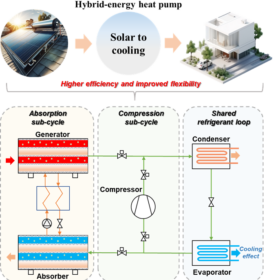
Scientists unveil hybrid-energy heat pump combining absorption and compression cycles
Researchers in Hong Kong have developed a hybrid-energy heat pump that seamlessly combines absorption and compression cycles using crystallization-free ionic liquids, improving efficiency and reliability across varying solar conditions. Simulations in multiple Chinese cities show the system can significantly cut electricity use and cooling costs, making it promising for sustainable building cooling and future commercial scaling.

Serbia installs 134.3 MW of solar in 2025
Serbia had a record year for solar additions in 2025, led by deployment of large-scale plants. The country has a gigawatt-size project pipeline, although most remain in the earlier stages of development and are not expected to come online this year.

France installs 5.9 GW of PV in 2025
The country’s cumulative installed PV capacity reached 31.1 GW at the end of December.

Ukraine deploys 1.5 GW of solar in 2025
The Solar Energy Association of Ukraine estimates around 1.5 GW of solar was added in the country last year, driven by growing interest in projects co-located with battery energy storage systems across market segments.
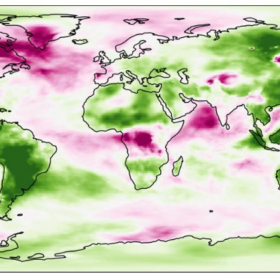
Aerosol divide in 2025 brings clearer skies to China and smoke to Europe
In a new weekly update for pv magazine, Solcast, a DNV company, reveales that last year extreme Canadian wildfires drove aerosol levels around 30% above normal, sharply reducing solar irradiance across Canada and even impacting Europe, while the Congo Basin also saw worsening aerosol conditions. In contrast, China and South America experienced unusually low aerosol levels, supporting stronger solar irradiance due to cleaner air, reduced fires, and favorable climate and policy conditions.

Solar PV will have a major role in marshalling our productivity to create a sustainable civilization
In all ages, humankind decided to spend considerable amounts of the available productivity on special monumental projects. Managing climate change and rebalancing within the planetary boundaries is such an activity. The enormous energetic productivity of solar PV may evolve as the central pillar to create a sustainable civilization.
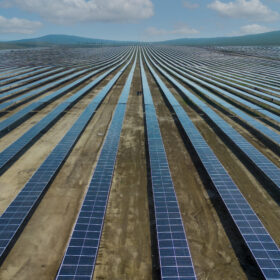
UAE’s massive solar-plus-storage project set to redefine baseload power, says Wood Mackenzie
Wood Mackenzie highlights a groundbreaking 5.2 GW solar-plus-storage project in the UAE capable of delivering 1 GW of continuous baseload power, signaling a potential shift in renewable energy deployment despite high costs. The report also forecasts strong global solar growth through 2030, including the rise of residential “balcony solar” in the U.S. and expanded solar shares in Asia Pacific and the U.S.

Solar generates record 13% of EU electricity in 2025
EU solar generation increased by over 20% for the fourth year running in 2025, with its share in the energy mix surpassing coal and hydro. For the first time in history, solar and wind generated more energy in the EU than fossil fuels.
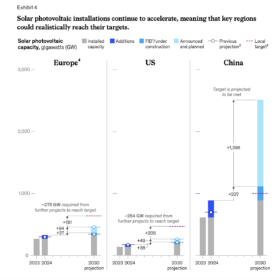
US, Europe on track for 2030 solar goals despite pipeline gaps
A report from McKinsey and Company says the relative ease of building out solar projects means the U.S and Europe are likely to meet their end-of-decade deployment targets, despite current pipeline gaps of around 205 GW and 181 GW.
