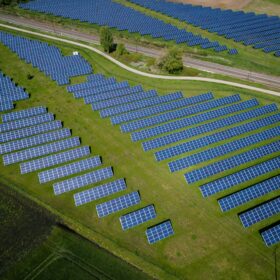
IRENA says solar capacity rose by 345.5 GW in 2023
The International Renewable Energy Agency (IRENA) says developers installed 345.5 GW of solar throughout the world in 2023. China mainly drove the surge, accounting for nearly three-quarters of all new renewable energy, but IRENA says more equitable growth will be needed to hit 2030 deployment targets.

NREL updates online tool with data for Africa, Eastern Europe, Middle East
The US Department of Energy’s National Renewable Energy Laboratory (NREL) has added a high-resolution solar data set covering Africa, Eastern Europe and the Middle East on its Renewable Energy Data Explorer tool.

Chinese PV Industry Brief: New PV hit 36.72 GW in January-February period
China’s National Energy Administration (NEA) says that the nation’s cumulative PV capacity hit 646.2 GW at the end of February.
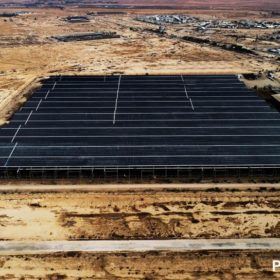
Israel hits 51% renewable production for first time
The Israeli government said that earlier this month, for several minutes, renewable energy accounted for most of the nation’s energy production. In particular, solar covered 45% of total generation.
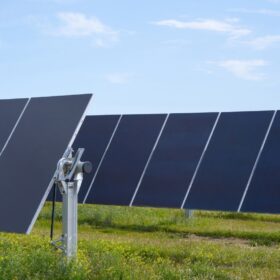
India sets efficiency requirements for cadmium telluride solar modules
India’s Ministry of New and Renewable Energy (MNRE) has established minimum efficiency standards for cadmium telluride (CdTe) thin-film solar modules to qualify for inclusion on the Approved List of Models and Manufacturers (ALMM).

Sweden records up to 1.4 GW of new solar for 2023
High interest rates, inflation, and customer uncertainty could slow down residential PV growth in Sweden this year, despite record solar installations in 2023, but interest in utility-scale PV remains strong.

Sprsun launches residential air source heat pump
The Chinese manufacturer said its new heat pump has a coefficient of performance of 4.2 at 7 C and a maximum heating capacity of 9.1 kW. It can reportedly achieve a topwater output temperature of 75 C.

Heat wave affects solar power generation in Brazil
A heat wave drove Brazil’s power demand up to a record high of 102 GW last week. However, it also affected solar power generation and pushed PV module operating temperatures to up to 60 C.
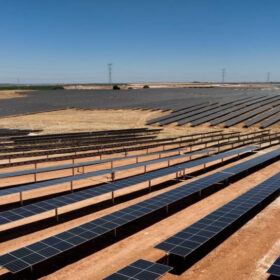
Spain’s installations of new PV systems hits 5.59 GW in 2023
Spain’s cumulative installed PV capacity surpassed 25.54 GW at the end of December 2023, on 5.59 GW of new solar installations for the full year.

Dutch PV additions hit 4.82 GW in 2023
The Netherlands deployed 4.82 GW of new solar capacity in 2023. The country’s cumulative installed PV capacity hit 24.4 GW at the end of December.
