
German PV experts develop quality standard for solar modules
The new Solar Module Quality Standard is based on VDE SPEC 90038-1. It will guarantee that PV modules have been produced and tested according to uniform quality criteria.
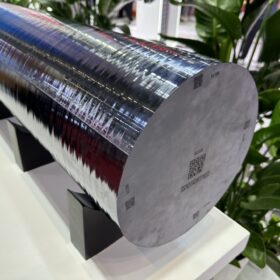
New US rules support solar supply chain, manufacturing
New US incentives support solar manufacturers and encourage the domestic build-out of the earlier stages of the solar supply chain.
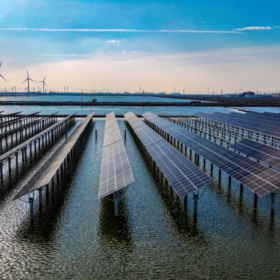
Chinese PV Industry Brief: China adds 160 GW in January-September period
China’s National Energy Administration (NEA) says solar installations reached 160 GW between January and September 2024, with cumulative capacity hitting 770 GW by August.
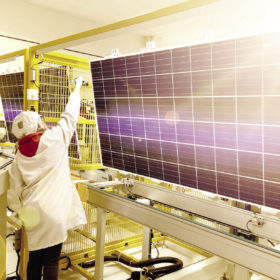
Trina Solar sues Canadian Solar for alleged TOPCon patent infringement
Trina Solar has filed a lawsuit against Canadian Solar in a US court, claiming patent infringement on an unspecified tunnel oxide passivated contact (TOPCon) solar cell technology.

Belgian grid operator accelerates smart meter deployment for PV system owners
Belgian grid operator Fluvius plans to install around 403,000 smart meters in solar-powered homes by 2025, when their use becomes mandatory. So far, the company has installed 553,500 smart meters in Flemish homes with PV systems.
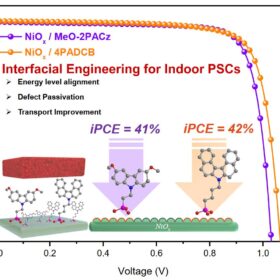
Indoor perovskite solar cell based on self-assembled monolayers achieves 42% efficiency
Researchers in Taiwan have developed an efficient carrier transport and defect passivation approach at the nickel oxide/perovskite interface in perovskite solar cells, enabling devices with 42% efficiency under indoor lighting conditions, and over 20% in simulated sunlight.

New hot-dip galvanized screw for ground-mounted solar projects
Spain-based Elementos de Sujeción Galvanizados (ESG) has developed a new hot-dip galvanized ground screw for PV systems, designed to be driven directly into the ground and withstand heavy loads.
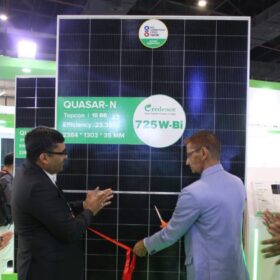
Credence unveils 725 W bifacial TOPCon solar module
The Indian manufacturer has unveiled an 18-busbar TOPCon bifacial solar panel featuring a power conversion efficiency of 23.35%.

Using texturized glass in building-integrated photovoltaics
Researchers from Poland have assessed how texturized glass used as the front cover of building-integrated photovoltaic panels affects performance. They have found power yield could be up to 5% lower compared to modules based on conventional glass, with reflection parameters being up to 88% in visible region.
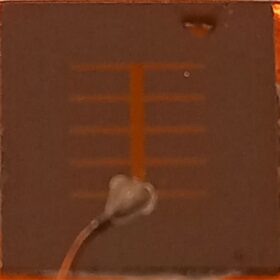
First attempt to build solar cells based on gallium phosphide, titanium
After conducting theoretical studies on gallium phosphide, titanium solar cells for years, a group of Spanish researchers has now sought to build the first intermediate band device based on this material combination and has found it can achieve enhanced external quantum efficiency at wavelengths above 550 nm.
