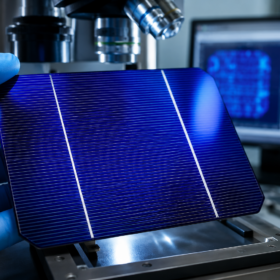
U.S. PV manufacturing capex could reach $7 billion in 2027 in breakout year for domestic supply-chain
Driven by multi-billion-dollar investments from the likes of Tesla and Corning, U.S. solar manufacturing capital expenditure is forecast to skyrocket 150% year-on-year to $7 billion in 2027, marking a massive breakout year as silicon-based technology eclipses thin-film spending and cements a domestic supply chain.
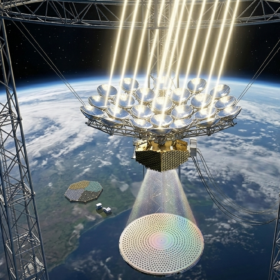
China conducts first experiments for space-based solar power plants
China is advancing the Sun Chasing project to develop space-based solar power systems that collect energy in orbit and beam it wirelessly to Earth or spacecraft for continuous power supply. Early tests demonstrated over 100 m wireless power transmission and efficient microwave beaming to moving targets, with up to 1,180 W delivered and promising system efficiencies.

DNV publishes new floating PV safety standards
Norwegian classification society DNV has published two new guidelines covering the structural design of floats for floating solar systems and their mooring and station keeping systems.
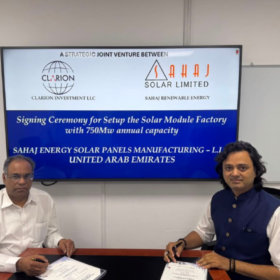
Sahaj Solar, Clarion plan 750 MW PV module factory in UAE
The plant will serve global markets, especially GCC countries and the United States, combining Sahaj Solar’s manufacturing expertise with Clarion Investments’ logistics capabilities.
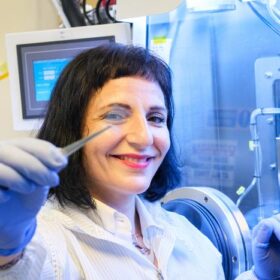
Researchers develop perovskite solar cells about 50 times thinner than conventional devices
Researchers at NTU Singapore have developed ultra-thin perovskite solar cells about 50 times thinner than conventional designs using a vacuum-based thermal evaporation process. The devices can be semi-transparent and energy-generating under diffuse light, making them promising for integration into building windows and facades.
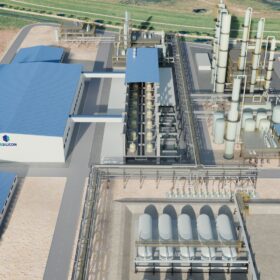
Can Europe build a competitive polysilicon industry?
Producing polysilicon in Europe remains challenging due to its energy-intensive, ultra-high-purity nature and the cost advantages of established Asian supply chains. However, Dutch startup Resilicon argues Europe can still make polysilicon by leveraging innovation and policy support. The company’s CEO, Remco Rijn, tells pv magazine how polysilicon factories could compete through cheap renewable energy supply and diversification.
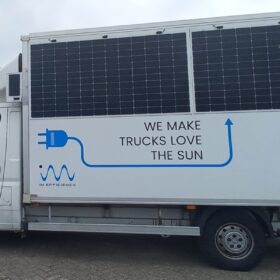
EVs equipped with vehicle-integrated PV could cover up to 80% of their electricity needs
A research project led by Fraunhofer Institute for Solar Energy Systems ISE has demonstrated that vehicle-integrated photovoltaics (VIPV) can significantly reduce strain on power grids. The concept is particularly relevant for the logistics sector, where trucks require large amounts of electricity for cooling, heating and auxiliary systems, while also offering extensive roof space for PV integration.
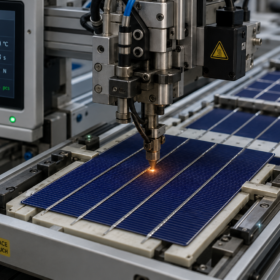
U.S. solar faces massive gap between stated capacity and real factory output
The U.S. solar industry tracks billions in new factory investments, but upstream bottlenecks and strict trade enforcement mean active factory production continues to trail behind headline numbers. Solar Energy Industries Association organized the American Solar and Storage Manufacturing Expo on Capitol Hill, which brought manufacturers together to highlight $43.1 billion in announced domestic manufacturing investments since 2022.
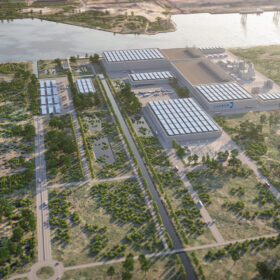
Carbon scraps solar module gigafactory project in France
Carbon’s gigafactory project in Fos-sur-Mer, designed to build a 5 GW integrated solar manufacturing chain in France, has been abandoned due to insufficient regulatory visibility and investor guarantees. Despite attempts to scale down and pursue partnerships, including with Chinese manufacturer Longi, the project collapsed amid uncertainty over EU industrial policy and market preference mechanisms.
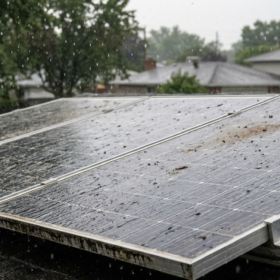
The impact of rain on PV module antisoiling coating lifetime
Researchers in India developed a predictive framework combining degradation experiments, weather data, and environmental stress models to assess how rain affects anti-soiling solar coatings. They found that coating lifetime strongly depends on local climate, installation tilt, and rainwater pH.
