
PVEL releases tenth edition of ‘PV Module Reliability Scorecard’
The independent test lab Kiwa PVEL names 53 manufacturers and 388 models–a record number of Top Performers in the ten-year history of the Scorecard.
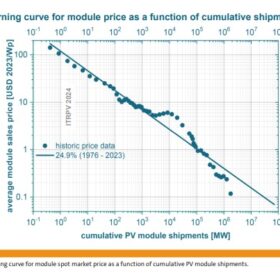
ITRPV says solar module prices fell 50% in 2023
The new edition of the International Technology Roadmap for Photovoltaic (ITRPV), published this week, reveals that the world’s installed PV capacity reached 1.6 TW at the end of last year. The learning curve, which reflects average module prices relative to cumulative shipments, is 24.9% for the period from 1976 to 2023.
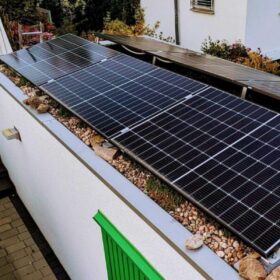
German startup offers plug-and-play 2.46 kW PV system
Wattando has developed a new rooftop PV solution that can be easily connected to a household’s power network via an AC connection. The system uses existing infrastructure and reportedly reduces installation work and time.
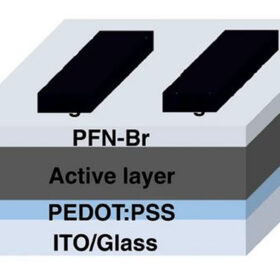
Organic solar cell based on trichlorobenzene achieves 19.31% efficiency
An international research team developed an organic solar cell based on a novel non-monotonic intermediated state manipulation strategy. The device reportedly showed non-radiative recombination losses while exhibiting remarkable power conversion efficiency.

Circular recycling approach aims for ‘perpetual utility’ of PV materials
After analyzing the future usage of material by the crystalline silicon PV industry, including glass, aluminum, silver, copper, ethylene-vinyl-acetate (EVA), and silicon, a German research team found that a circular recycling approach could address foreseeable supply problems. It could also reportedly become economically sustainable.

ABB launches smart panel for home energy management
ABB says it has launched a smart panel for home energy management in partnership with Lumin, featuring software to control solar, batteries, and electric-vehicle chargers.
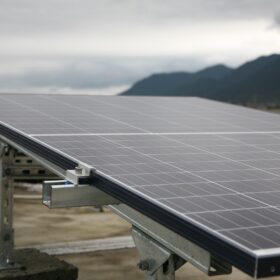
Low tilt angles ideal for regions with high summer load demand
New research from India shows the advantages of deploying fixed tilt PV systems with low angles in regions with high summer load demand like India. The scientists said that, although PV systems with low tilt angles may not achieve maximum power yield or the lowest levelized cost of energy (LCOE), they can reduce reliance on expensive grid electricity during high-demand periods.
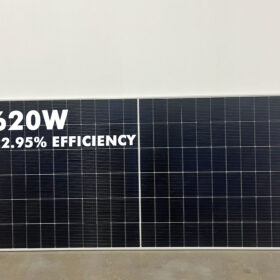
Leapton Energy debuts 600-625 W TOPCon solar panel based on rectangular wafers
Leapton says its new panels have a temperature coefficient of -0.30% per C and an efficiency of up to 23.14%. They come with a 30-year power output guarantee for 87.4% of the initial yield.

Energy Vault unveils design partnership for gravity storage in skyscrapers
The partnership will see architecture and engineering firm Skidmore, Owings & Merrill (SOM), responsible for some of the world’s tallest buildings, incorporate Energy Vault’s gravity energy storage technology into tall buildings in urban environments and deployable structures in natural environments.

The Hydrogen Stream: Europe launches pilot to improve market transparency
The European Commission says it has started working on a new pilot mechanism, and Italy has agreed to expand collaboration with Austria and Germany, while also supporting cooperation between Italian companies and Finland’s Wärtsilä.
