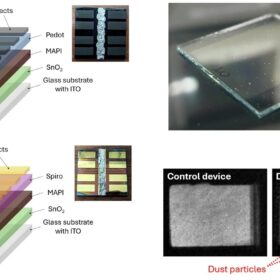
Perovskite solar cells can be made without expensive cleanrooms
Swansea University researchers found that perovskite solar cells can tolerate dusty fabrication environments, performing almost as well as those made in cleanrooms. The findings suggest low-cost, scalable production may be possible without ultra-sterile conditions, potentially accelerating cell and module manufacturing.
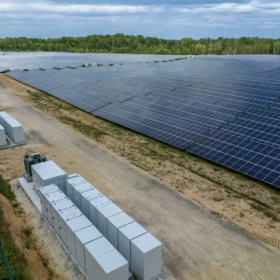
France proposes linking solar subsidies to storage as prices turn negative
France’s energy regulator plans to link PV support to storage as negative power prices increase and reduce solar revenues.

Solar curtailment reaches Tokyo, Japan’s last holdout grid area
Tokyo’s grid has joined every other transmission system operator area in Japan in experiencing economic curtailment, as solar output growth outpaces the flexibility of the country’s largest regional power market.
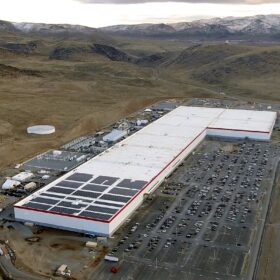
Tesla advances plan to build 100 GW of U.S. PV manufacturing capacity by 2028
Job advertisements on Tesla’s website outline the 100 GW ambition and follow reports the company is in talks with Chinese firms for the purchase of $2.9 billion worth of equipment for solar manufacturing.
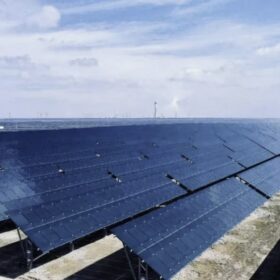
GCL Optoelectronics wins China’s first commercial perovskite-silicon tandem PV module order
GCL Optoelectronics has won a 1.2 MW commercial perovskite/silicon tandem solar module tender held by China’s Huaneng. The procurement required mass-producible, IEC-certified modules with over 26% efficiency, a 25-year performance warranty, and delivery by June 2026.

Why battery storage is becoming the engine of AI growth
Data centers are using batteries to run more AI on the same grid connection.

Slovakia deploys 243 MW of solar in 2025
Slovakia’s total solar additions last year fall in line with those seen the prior two years, with cumulative capacity now standing in excess of 1.3 GW.
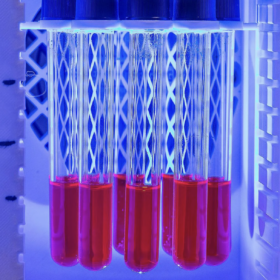
Molecular solar battery stores energy for days, yields hydrogen on demand
Researchers at Ulm University and Friedrich-Schiller-Universität Jena have built a molecular system that captures solar energy in a water-soluble redox copolymer, stores it at more than 80% charging efficiency for several days, and releases it as hydrogen with 72% conversion efficiency whenever required.
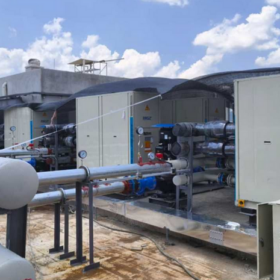
PVT-driven tower heat pump for building retrofits
Researchers in China demonstrated that integrating energy tower heat pumps with evaporator-side boilers, air-source heat pumps, or solar-assisted systems can significantly improve winter heating efficiency and economic performance in commercial buildings. Among the four configurations tested, the evaporator-side boiler and solar-assisted systems delivered the highest performance and energy savings, offering a sustainable, low-carbon alternative to conventional heating.

Solar panels and low-carbon heating mandated for new homes in England
Heat pumps and solar PV effectively mandated under new building regulations for England. UK government says it is stepping up push for clean power in response to Iran war. Major UK retailers expected to have first plug-in solar devices on shelves within months.
