
Solar curtailment reaches Tokyo, Japan’s last holdout grid area
Tokyo’s grid has joined every other transmission system operator area in Japan in experiencing economic curtailment, as solar output growth outpaces the flexibility of the country’s largest regional power market.
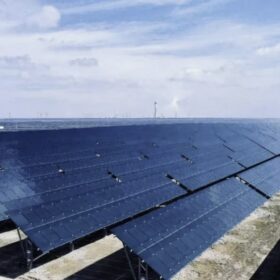
GCL Optoelectronics wins China’s first commercial perovskite-silicon tandem PV module order
GCL Optoelectronics has won a 1.2 MW commercial perovskite/silicon tandem solar module tender held by China’s Huaneng. The procurement required mass-producible, IEC-certified modules with over 26% efficiency, a 25-year performance warranty, and delivery by June 2026.
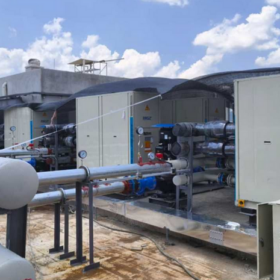
PVT-driven tower heat pump for building retrofits
Researchers in China demonstrated that integrating energy tower heat pumps with evaporator-side boilers, air-source heat pumps, or solar-assisted systems can significantly improve winter heating efficiency and economic performance in commercial buildings. Among the four configurations tested, the evaporator-side boiler and solar-assisted systems delivered the highest performance and energy savings, offering a sustainable, low-carbon alternative to conventional heating.
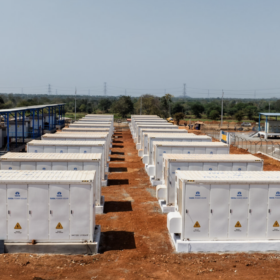
Indian industry body projects 346 GWh of BESS capacity by 2033
India’s cumulative installed battery energy storage system (BESS) capacity is projected to reach 346 GWh by 2033 from less than 1 GWh today, according to a white paper by the Indian Energy Storage Alliance (IESA) and Customized Energy Solutions (CES).
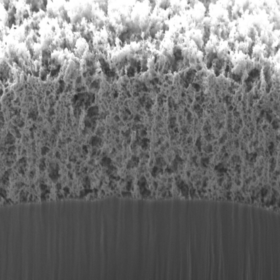
The Hydrogen Stream: Ionautics advances catalyst toward production
Sweden’s Ionautics has advanced its platinum-based hydrogen catalyst toward full-scale industrial production, while thyssenkrupp nucera has signed contracts for 300 MW of alkaline electrolysis capacity in Spain and 260 MW in India.
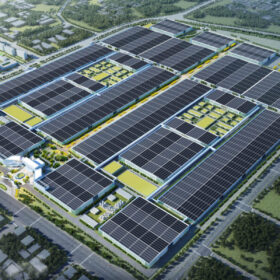
Chinese PV Industry Brief: JinkoSolar appoints new CEO
JinkoSolar has appointed Cao Haiyun as chief executive, while PowerChina has shortlisted 26 suppliers for a 31 GW solar module tender for 2026.
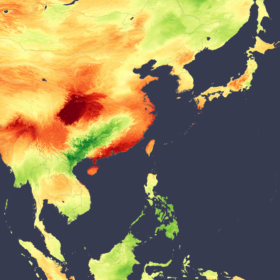
Clean Winter air drives major irradiance surplus across China and Taiwan in February
In a new weekly update for pv magazine, Solcast, a DNV company, reports that February saw a sharp East Asia solar divide, with southern China and Taiwan experiencing record-high irradiance due to clear skies and low aerosols, while maritime Southeast Asia faced heavy rainfall and below-average irradiance from enhanced tropical convection. The surplus in China was driven by atmospheric cleanliness, whereas Taiwan’s boost came mainly from persistently clear days, contrasting with widespread deficits across Indonesia, the southern Philippines, and nearby islands.
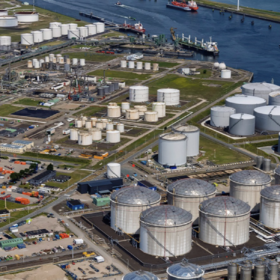
Reliance Industries, Samsung C&T sign $3 billion green ammonia supply deal
Reliance Industries has signed a 15-year green ammonia supply agreement with Samsung C&T Corp., marking one of the largest long-term offtake deals globally.

Japan sets FIT terms for small PV, rooftop solar as large-scale auctions end
The Japanese government has set 2026 feed-in tariff (FIT) terms for solar below 250 kW, set the renewable energy levy at JPY 4.18 ($0.026)/kWh, and confirmed that feed-in premium (FIP) auctions for large-scale solar will end after 2026.
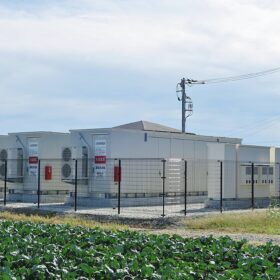
Panasonic claims world’s first trial of cybersecurity monitoring for grid-scale BESS
A Japanese joint-pilot will test grid-scale BESS with a range of local and remote attack vectors, with cybersecurity monitoring to watch for indications of anomalies.
