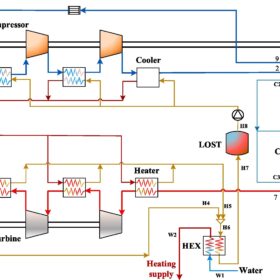
PV-driven liquid air storage system for buildings
An international research group has developed a PV-driven liquid air energy storage (LAES) system for building applications. Simulations suggest that it could meet 89.72% of power demand, 51.96% of heating demand, and 11% of cooling demand in a PV-powered building.
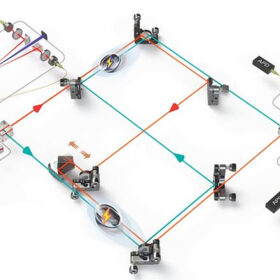
Charging quantum batteries
Researchers in Japan have taken advantage of an unintuitive quantum process that disregards the conventional notion of causality to improve the performance of so-called “quantum batteries.” They believe these advances could help to bring the technology a little closer to reality.
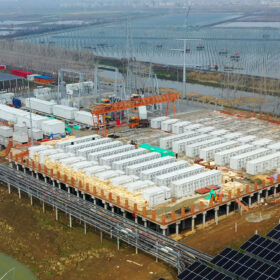
Trina Storage delivers 50 MWh energy storage system to fishery in China
Trina Storage has supplied a 50 MWh storage system to a hybrid fishery-solar-storage project in China. The installation includes 10 2.5 MW/5 MWh battery cabinets and combines sustainable farming with cutting-edge technology.
PFC Consulting allocates 1.25 GW of solar for $0.030/kWh
NTPC Renewable Energy has secured 900 MW in PFC Consulting’s latest 1.25 GW solar auction. Acme Cleantech won 300 MW and Solarcraft took 50 MW.

Red Solar claims 26.01% efficiency for TOPCon bifacial solar cell
Chinese manufacturer Red Solar says its new 182 mm bifacial solar cell, which is based on tunnel oxide passivated contact (TOPCon) tech, has an efficiency of 26.01%.
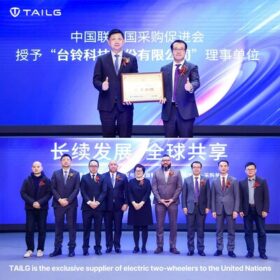
TAILG unveils two-wheelers powered by sodium-ion batteries
China-based TAILG has revealed its new sodium-ion battery technology. The company’s luxury e-bikes will be the first to feature its sodium-ion batteries, and they will initially be available in China.
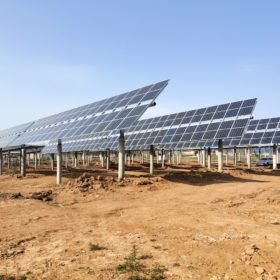
Chinese PV Industry Brief: Tongwei unveils $4 billion upstream investment
Tongwei has revealed a new upstream investment plan in Inner Mongolia, while China Huadian has completed its latest 2023 central procurement round, securing 8.95 GW of PV panel products from JA Solar, Astronergy, Das Solar, Trina Solar, and Longi.
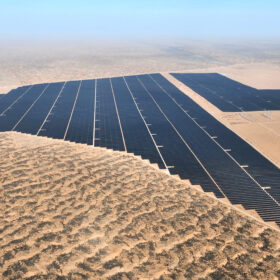
SOFAR powers 300 MW of utility-scale PV in China
China’s SOFAR has supplied more than 1,300 units of its SOFAR 255KTL-HV string inverters for a 300 MW utility-scale solar project in Gansu, China. The desert PV plant is one of several ongoing projects that SOFAR is working on in partnership with PowerChina.

Vaysunic launches hybrid photovoltaic water heater
The Chinese manufacturer says that its new V series heaters can use either PV or AC grid power. It can also be controlled and monitored via WiFi.
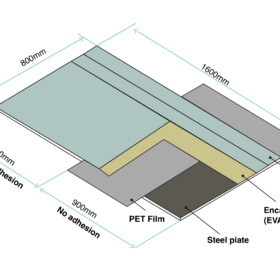
Korean researchers explore viability of BIPV panels based on steel plates
A team from South Korea’s Research Institute of Industrial Science and Technology (RIST) has developed a new method to increase the adhesion performance of EVA and POE on steel plates. The proposed technique may be applied to BIPV modules that use steel panels instead of backsheets.
