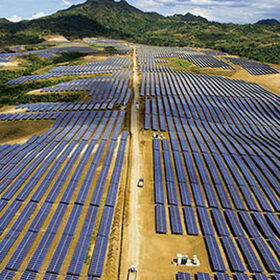
Solar Philippines begins working on 4 GW solar park
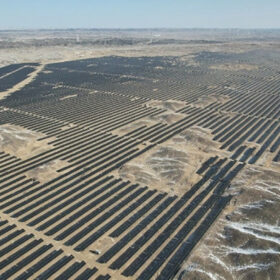
Solar Philippines says it has broken ground on what it touted to be the world’s largest solar array – a 4 GW solar park spread across 3,500 hectares of land in the northern part of the country.
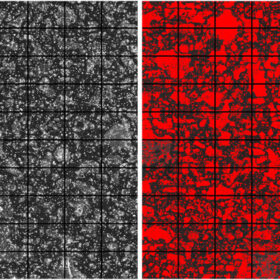
Researchers apply thresholding to PV soiling image analysis
Thresholding methods have commonly been used to characterize the soiling accumulated on glass coupons. Researchers led by the Sapienza University of Rome have identified 16 automatic thresholding methods that may be used for analyzing soiling on PV panels.
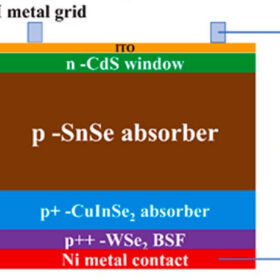
Novel tin selenide solar cell design promises 36.45% efficiency
Tin selenide solar cells have so far reached limited efficiencies in real applications. Bangladeshi scientists claim to have found a way to drastically improve their performance by adding a copper/indium/selenium (CIS) thin-film layer and a back surface field (BSF) layer.
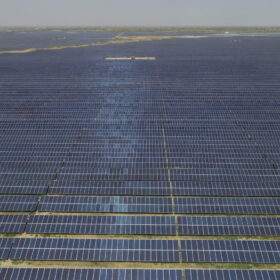
India’s SECI launches 1.5 GW solar tender
Solar Energy Corp. of India (SECI) has started accepting bids to develop 1.5 GW of solar projects on a build-own-operate basis. The projects can be located anywhere in India. Bidding closes on Jan. 31.
China Three Gorges commissions 3.48 GW of new solar capacity
China Three Gorges Corp., a Chinese state-owned power company, connected 3.48 GW of solar to the grid at seven sites in the final week of December. The projects include China’s largest floating PV plant – a 650 MW facility in Anhui province – and two PV plants with capacities of 1 GW and 900 MW.

Solar module prices in India ‘likely to remain subdued in the near term’
Vikram V, vice president and co-group head of corporate ratings at Indian investment information and credit rating agency ICRA Ltd, speaks to pv magazine about falling solar cell and module prices, the impact on Indian pv manufacturers, and the way forward.
Chinese PV Industry Brief: Longi cuts wafer prices by 29%
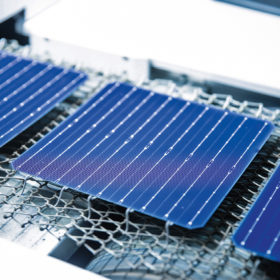
Longi has reduced its wafer prices by 29%, while Sungrow Hydrogen has supplied electrolyzers for an integrated hydrogen mining complex in Hubei province.
PV-driven liquid air storage system for buildings
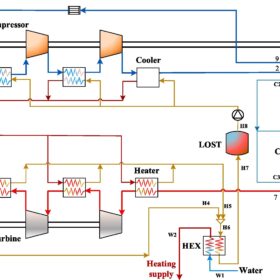
An international research group has developed a PV-driven liquid air energy storage (LAES) system for building applications. Simulations suggest that it could meet 89.72% of power demand, 51.96% of heating demand, and 11% of cooling demand in a PV-powered building.
Charging quantum batteries
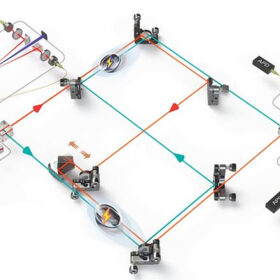
Researchers in Japan have taken advantage of an unintuitive quantum process that disregards the conventional notion of causality to improve the performance of so-called “quantum batteries.” They believe these advances could help to bring the technology a little closer to reality.
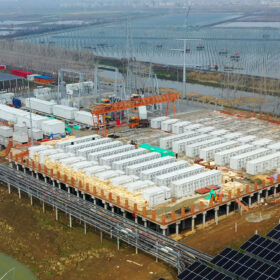
Trina Storage delivers 50 MWh energy storage system to fishery in China
Trina Storage has supplied a 50 MWh storage system to a hybrid fishery-solar-storage project in China. The installation includes 10 2.5 MW/5 MWh battery cabinets and combines sustainable farming with cutting-edge technology.
