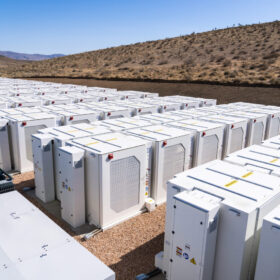
Moldova launches tender for 75 MW of battery storage
The procurement aims to improve the reliability of Moldova’s grid, facilitate energy trade with neighboring Romania and Ukraine, and support the integration of locally produced renewable energy.

Roofit.Solar releases new BIPV panels with narrow roof coverage
Estonia’s Roofit.Solar has developed new building-integrated photovoltaic (BIPV) panels with an effective width of 470 mm, offering power outputs of 120 W or 180 W.

Czechia installs 967 MW of solar in 2024
Czechia installed 967 MW of solar in 2024, driven by residential and commercial and industrial (C&I) projects, which accounted for 930 MW of the total, says the Czech Solar Association (Solární Asociace).

The Hydrogen Stream: Algeria, EU nations plan Southern Hydrogen Corridor
Algeria, Austria, Germany, Italy, and Tunisia have agreed to develop the Southern Hydrogen Corridor linking North Africa and Europe, while Sungrow Hydrogen has signed a deal to supply electrolysis gear for ACME’s 320 MW green ammonia project in Oman.
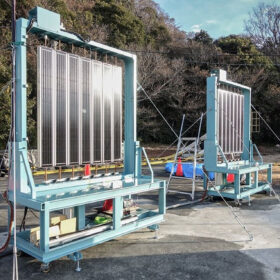
Novel BIPV concept integrates louvers to enhance power production
Scientists have proposed a building-integrated PV system that integrates airflow to cool the panels and control room temperature. The system, which also acts as a shading device, can reportedly mitigate drops in power generation efficiency without additional energy consumption.
Romania allocates €150 million for standalone battery storage rollout
The Romanian Ministry of Energy has announced a new round of funding from the Modernization Fund dedicated to battery energy storage systems.
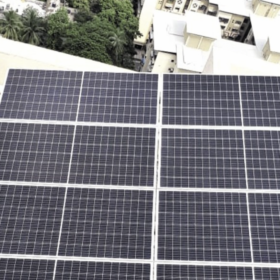
India’s rooftop solar scheme could drive $13.9 billion opportunity
India’s PM Surya Ghar Muft Bijli Yojana initiative (PM-SGMBY) could create a INR 1.2 trillion ($13.9 billion) opportunity for PV module, inverter, and component manufacturers, benefiting project developers and engineering, procurement, and construction (EPC) contractors, according to SBICAPS.
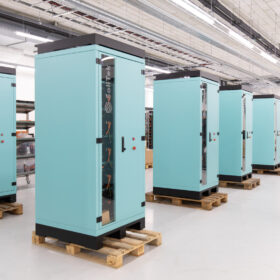
SoliTek launches made-in-Lithuania, high-voltage C&I battery energy storage solution
The new 51.2 kWh modular storage system connects to European wholesale electricity markets such as NordPool and uses artificial intelligence (AI) to track and analyze dynamic tariffs. It offers three-phase backup and is virtual power plant-ready.

China begins building first GW-scale residential VPP
China is building its first gigawatt-scale residential virtual power plant (VPP) in Jiangsu province. The project will connect millions of high-power household appliances to a cloud-based energy pool to improve grid stability and boost renewable energy use.
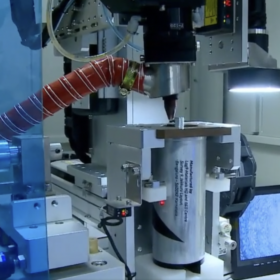
India eyes self-reliance in battery cells with lithium recycling push
India could achieve self-reliance in battery cell manufacturing by domestically recycling lithium and reusing it in batteries, an Indian government official claimed this week at a battery manufacturing conference in in New Delhi.
