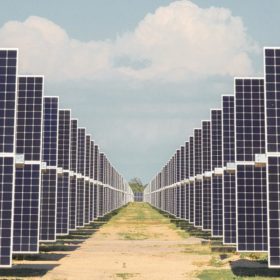
Negative power prices reach all-time high on the Iberian Peninsula in Q1
Spain and Portugal recorded a surge in negative electricity prices in Q1, driven by strong solar generation and relatively low demand on the Iberian Peninsula. Further records are likely in 2026 as solar capacity grows, with more frequent price volatility expected across Europe.
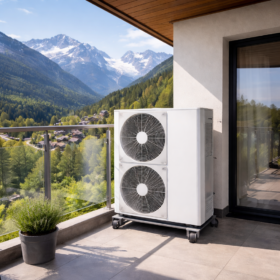
Could global warming improve heat pump efficiency in Alpine regions?
Researchers in Italy analyzed air-to-water heat pump performance in Alpine regions, focusing on how start-up and defrost cycles affect efficiency under current and future climate conditions. Their simulations show that while warmer temperatures slightly reduce defrosting losses and modestly improve efficiency, start-up cycling losses remain significant and continue to limit overall performance gains.

Solar rebound effect could raise Europe’s electricity demand 5% by 2050
Research from Germany’s FernUniversität Hagen finds the solar rebound effect, caused by households increasing their total electricity consumption after installing a solar system, is currently a blind stop in Europe’s energy system planning and abatement scenarios.
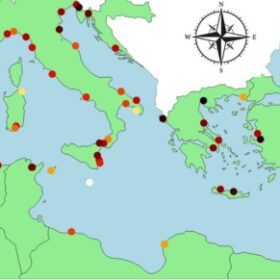
The Hydrogen Stream: Levelized cost of hydrogen at Mediterranean ports can be as low as €2.5/kg for hybrid systems
A study from the University of Naples Federico II finds hydrogen production at Mediterranean ports could cost €5.7–8.6/kg using only renewables and €2.5–13/kg in hybrid systems, with solar emerging as the most reliable resource and wind outperforming it in select locations. Alongside these findings, major industry developments include new hydrogen and e-fuel projects, advanced electrolyser technologies, and EU-backed infrastructure expansion supporting large-scale decarbonization.

‘I approach inclusion from a perspective of fairness and performance’
This week Women in Solar+ Europe gives voice to Carla Vico, CEO of France’s Green Solver. She says building an inclusive culture means valuing people for their work, accountability, and commitment, rather than their gender or background. “I do not believe in positive discrimination; I believe in creating equal opportunities and making merit-based decisions,” she states.

Will we finally buy European PV modules?
In a new monthly column for pv magazine, the Becquerel Institute explains why Europe’s solar manufacturing outlook is shifting from decline to cautious opportunity, driven by rising energy uncertainty and new regulations like the Net-Zero Industry Act that create fragmented, nationally defined markets with partial protection for domestic producers. While demand and policy support are strong, complexity, uneven implementation, and competition risks mean success will depend on how quickly and strategically industry players navigate this narrow window.

Italy installs 1.43 GW of PV in Q1
The country reached a cumulative installed PV capacity of 44.9 GW at the end of March, according to recent figures from Italian PV association Italia Solar.

France deploys 1.41 GW of solar in Q1
New figures from grid operator Enedis reveal that France added 1,418 MW of new PV capacity in Q1 2026, roughly matching Q1 2025, despite a broader sector slowdown linked to regulatory changes and delayed tenders.
New metric shows renewables are 53% cheaper than nuclear power
A new metric for assessing total system costs puts a least-cost mix of offshore wind and solar at about €46 ($54.20)/MWh in a future climate-neutral energy system for Denmark. Researchers tell pv magazine that figure is less than half the equivalent cost of nuclear under the same conditions.
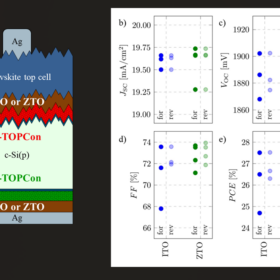
Perovskite–silicon tandem solar cells using zinc-doped tin oxide achieve comparable performance to indium tin oxide counterparts
Fraunhofer ISE-led researchers demonstrated zinc-doped tin oxide (ZTO) as an indium-free alternative to indium tin oxide (ITO) for recombination layers in fully textured perovskite–silicon tandem solar cells. ZTO delivers comparable device efficiencies of 27–28% under current-matching conditions, offering a scalable, indium-free pathway for high-performance tandem photovoltaics without efficiency loss.
