The Hydrogen Stream: Levelized cost of hydrogen at Mediterranean ports can be as low as €2.5/kg for hybrid systems
A study from the University of Naples Federico II finds hydrogen production at Mediterranean ports could cost €5.7–8.6/kg using only renewables and €2.5–13/kg in hybrid systems, with solar emerging as the most reliable resource and wind outperforming it in select locations. Alongside these findings, major industry developments include new hydrogen and e-fuel projects, advanced electrolyser technologies, and EU-backed infrastructure expansion supporting large-scale decarbonization.
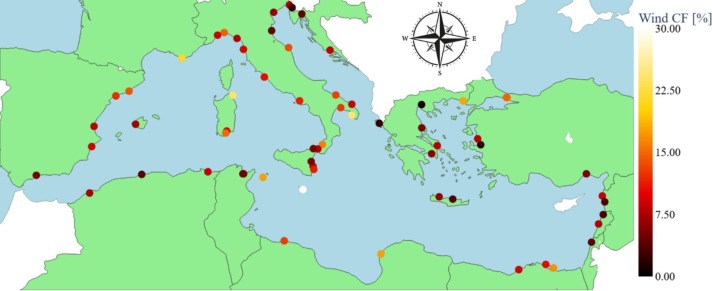
PV capacity factor for the analyzed Mediterranean ports
Image: Energy Conversion and Management/ CC BY 4.0
Share
A group of researchers from the University of Naples Federico II in Italy has found that the levelised cost of hydrogen (LCOH) for the fuel being produced at Mediterranean ports could range from €5.7-8.6 ($6.5-10.1)/kg in fully renewable configurations to €2.5-13/kg in hybrid systems, depending on grid electricity prices and emission intensities. “Solar energy emerges as the most consistent resource, with capacity factors ranging from approximately 18% to 24%, while wind energy can outperform solar in specific locations, reaching values close to 30%,” said the researchers. The study is structured into three phases, starting with the collection and processing of geographic, infrastructural, and meteorological data for ports worldwide. Ports are characterised using GIS data, including location, logistics, economic relevance, and renewable resource availability such as solar, wind, and wave energy. Weather datasets like ERA5 and CMEMS are used to generate location-specific renewable energy profiles. In the second phase, energy production from photovoltaic systems, wind turbines, and wave energy converters is modelled based on local conditions. The generated electricity powers electrolysers for hydrogen production, supported by battery storage systems to manage fluctuations. Two operational strategies are considered: fully renewable-based hydrogen production and grid-supported fixed-load electrolysis. The third phase evaluates techno-economic and environmental performance using indicators like levelised cost and emissions of hydrogen. The results show that renewable energy performance varies significantly across Mediterranean ports, with solar energy consistently reliable while wind and wave are more location-dependent. Capacity factors reveal that solar exceeds 15% everywhere, whereas wind and especially wave can be very low, limiting their feasibility. Solar energy is the most consistently viable source across Mediterranean ports, with capacity factors ranging 18.1% – 24.4%,” the scientists said. “Wind energy can outperform solar in specific locations but is highly site-dependent.” Their findings are available in the study “The role of Mediterranean ports in the energy transition: assessment of hydrogen production potential,” published in Energy Conversion and Management.
Jaze New Energy has begun construction of a 300,000-ton green hydrogen–to–aviation fuel project in Jidong County, Jixi City, Heilongjiang Province. The Chinese company is investing a total of CNY 3.557 billion ($521.4 million) and reported revenues of CNY 2.499 billion in 2025. The plant will combine straw and corn cob resources with wind energy.
ITM Power has entered a strategic collaboration with Rheinmetall to support the German company’s Giga PtX project, which aims to establish a Europe-wide network of decentralized synthetic fuel plants for NATO armed forces. The project envisions several hundred facilities across Europe, each with up to 50 MW of electrolysis capacity, producing approximately 5,000 to 7,000 tonnes of e-fuel annually. The collaboration will initially focus on the UK.
Ceres has launched its solid oxide stack platform operating at 450–630 C, claiming around 30% higher efficiency than conventional low-temperature electrolysis. The company states that systems can be installed within months, reducing delays linked to grid upgrades. The platform supports high-voltage DC architectures up to 800 V and enables fast load response within a compact footprint.
Sunfire has introduced a new 50 MW outdoor, 30-bar(g) pressurized alkaline electrolyzer system. The design centralizes key components, integrates air cooling, and increases prefabrication, simplifying installation and commissioning while reducing overall plant costs.
Hamburg’s Authority for Environment, Climate, Energy and Agriculture (BUKEA) has granted MB Energy a permit to build and operate a new ammonia import terminal at the Blumensand tank terminal in the Port of Hamburg. Subject to a final investment decision, the facility is expected to become Germany’s first large-scale ammonia import hub, with a planned throughput of 600,000 metric tonnes per year.
The European Commission has published the second list of Projects of Common Interest (PCIs) and Projects of Mutual Interest (PMIs), covering 235 cross-border energy infrastructure projects. The list includes 100 hydrogen and electrolyser projects, three smart gas grid projects, and 17 CO₂ network initiatives aimed at supporting decarbonisation and reducing reliance on fossil fuel imports.
This content is protected by copyright and may not be reused. If you want to cooperate with us and would like to reuse some of our content, please contact: editors@pv-magazine.com.
By submitting this form you agree to pv magazine using your data for the purposes of publishing your comment.
Your personal data will only be disclosed or otherwise transmitted to third parties for the purposes of spam filtering or if this is necessary for technical maintenance of the website. Any other transfer to third parties will not take place unless this is justified on the basis of applicable data protection regulations or if pv magazine is legally obliged to do so.
You may revoke this consent at any time with effect for the future, in which case your personal data will be deleted immediately. Otherwise, your data will be deleted if pv magazine has processed your request or the purpose of data storage is fulfilled.
The cookie settings on this website are set to "allow cookies" to give you the best browsing experience possible. If you continue to use this website without changing your cookie settings or you click "Accept" below then you are consenting to this.






By submitting this form you agree to pv magazine using your data for the purposes of publishing your comment.
Your personal data will only be disclosed or otherwise transmitted to third parties for the purposes of spam filtering or if this is necessary for technical maintenance of the website. Any other transfer to third parties will not take place unless this is justified on the basis of applicable data protection regulations or if pv magazine is legally obliged to do so.
You may revoke this consent at any time with effect for the future, in which case your personal data will be deleted immediately. Otherwise, your data will be deleted if pv magazine has processed your request or the purpose of data storage is fulfilled.
Further information on data privacy can be found in our Data Protection Policy.