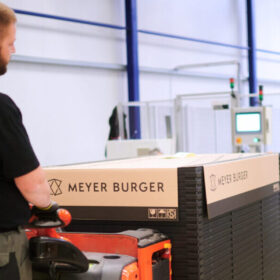
Meyer Burger’s German subsidiaries file for insolvency
Meyer Burger said it filed for insolvency for its German subsidiaries, following intensive efforts to keep Meyer Burger Industries GmbH and Meyer Burger Germany GmbH operational.
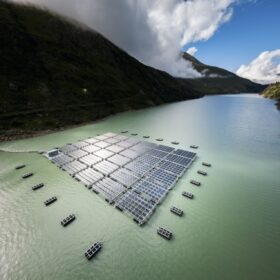
Floating PV systems could increase the climate resilience of lakes
Germany’s Fraunhofer Institute for Solar Energy Systems (Fraunhofer ISE) has conducted new research on the impact of floating PV and water temperature and evaporation.
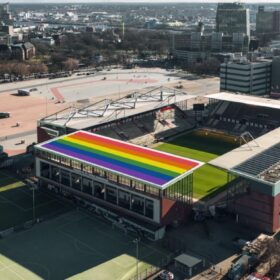
Germany’s FC St. Pauli to install rainbow-colored stadium PV array
German soccer club FC St. Pauli is installing a 316 kW rainbow-colored photovoltaic system on its stadium roof using 1,080 modules supplied by Switzerland’s Megasol Energie.

Fraunhofer ISE creates startup for agrivoltaics
The Fraunhofer Institute for Solar Energy Systems ISE (Fraunhofer ISE) has launched Diveo GmbH to plan and construct different kinds of agrivoltaic facilities without focusing on specific technologies.
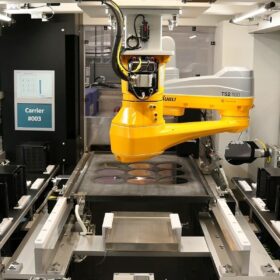
Vision-assisted robotics for space solar cell manufacturing
German automation specialist Acp systems developed an advanced robotics solution integrating image processing to handle a range of wafer sizes and tolerances within a vapor deposition process for a manufacturer of space solar cell technologies. The requirements included a compact design, precsion within 0.1 mm and automated wafer handling quality control.
EU updates Photovoltaic Geographical Information System
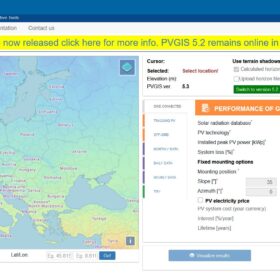
The EU Joint Research Centre (JRC) has updated the core technologoy of the Photovoltaic Geographical Information System with the aim of reflecting the dominance of crystalline silicon solar technologies over thin-film counterparts in the global energy market.
Swiss developer breaks ground on 800 MW/1.6 GWh redox flow storage project
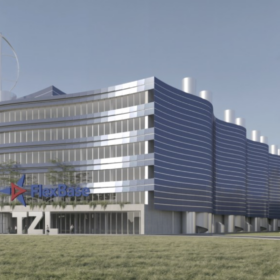
Flexbase Group has broken ground on an 800 MW/1.6 GWh redox flow battery project in Laufenburg, Switzerland, in what could become one of Europe’s largest flow storage systems. The multi-use site will integrate utility-scale storage, an AI data center, and district heating.

Fraunhofer ISE developing InP-on-GaAs substrates for III-V solar cells
Fraunhofer ISE researchers say their newly fabricated gallium arsenide substrates (InP-on-GaAs wafers) can replace prime indium phosphide wafers and offer a scalable pathway to lower costs.
Q3 Energy presents string combiner box with fault detection
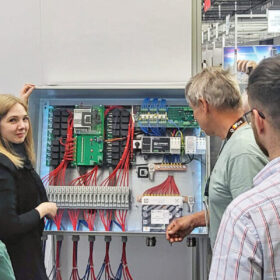
Q3 Energie showcased a new string combiner box at Intersolar Europe 2025. The generator junction box can detect and isolate faults in photovoltaic systems.

The Hydrogen Stream: EU backs 15 hydrogen projects
The European Commission has selected projects for €992 million ($1.1 billion) of EU public funding, while the Japanese government has agreed to provide $4.80 in subsidies for hydrogen fuel cell trucks.
