
Mexico advances new wave of large-scale solar and storage projects
Mexico is seeing a surge of large-scale solar and battery storage proposals across multiple states following an October decree that sets clearer rules for private energy investments.
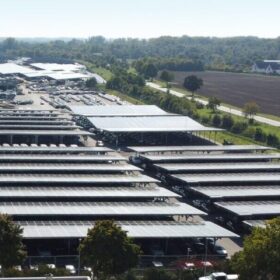
German developer commissions nation’s largest solar carport
Germany has brought a 17 MW photovoltaic carport online in Riedstadt, Hesse, spanning 76,000 square meters. It is expected to generate about 17 GWh per year, according to project developer Nawasol.

Plenitude tests perovskite-silicon tandem solar modules in utility-scale installation pilot
The Italian renewable energy company said it will validate Swift Solar’s 28% efficiency perovskite-silicon tandem technology in a utility-scale project.

When solar meets next-gen nuclear
Scientists in China have proposed a novel scheduling framework for microgrids based on hybrid PV and a small modular nuclear reactors. The framework uses multi-objective distributionally robust optimization with a real-time reinforcement learning mechanism and is reportedly able to reduce operational costs by 18.7%.

Italy issues new rules for PV project siting, solar fiscal breaks
The Italian government has reduced the regions’ influence on permits for photovoltaic and wind energy by centralizing the decision-making process. It has also issued new rules for tax relief under the so-called Transizione 5.0 Decree.

Brazil distributed solar market set for lower annual additions in 2025
Brazil installed 6.4 GW of distributed solar capacity between January and September 2025, down 12% from the same period in 2024, and current installation rates point to about 8.5 GW for the full year as residential and commercial segments weaken and regulatory reporting delays persist.

Capture price exposes true performance of solar plants
French solar engineering firm kiloWattsol says technical assessments show that capture-price analysis provides a more accurate measure of photovoltaic asset performance than France’s monthly M0 benchmark, as price volatility and negative wholesale prices increase.
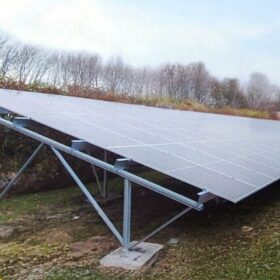
French steel manufacturer unveils reusable mounting structure for large-scale solar
French steel manufacturer Manorga says its new Solterra system uses modular, demountable components to enable reversible deployment of ground-mounted solar plants across varied sites and soil conditions.

Bahrain runs 3 MW solar tender
A tender is open in Bahrain for the design, construction, installation and commissioning of a 3 MW grid-tied solar power plant for the country’s General Sport Authority. A closing date for applications has not been disclosed.

Paraguay set to host autonomous solar-powered data center
Sollar Machine plans to build a $9 million off-grid data center in Paraguay powered entirely by solar and batteries to deliver high-performance computing services for international clients, with a focus on AI.
