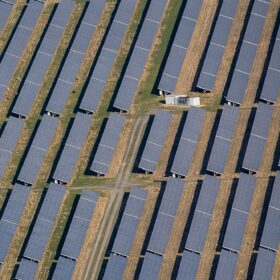
Malaysia’s Sand Town Solar secures financing for 29.9 MW of solar
Sand Town Solar Sdn Bhd (STS) has signed a MYR 91.5 million ($19.3 million) financing agreement with Bank Islam for a 29.99 MW solar farm in the state of Perak, northwestern Malaysia.

New solar carport from France
French pergola specialist Heolian has presented its new Atrium Electron carport solution. The system is equipped with 21.8%-efficient 425 W bifacial modules produced by French manufacturer Duoenergy and microinverters.
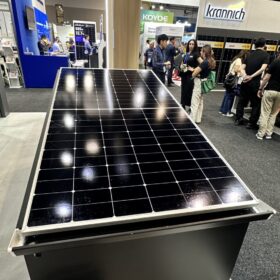
Longi launches anti-dust solar module for C&I segment
Chinese solar manufacturer Longi has developed a new “anti-dust” module for the commercial and industrial (C&I) market in Australia. The frame sits flush against the glass on the short side, allowing water to wash off.
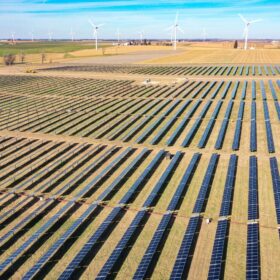
Molson Coors brews beer with 300 MW solar project
Molson Coors is brewing beer with a 300 MW solar project developed by Invenergy. The installation is the largest in the US state of Wisconsin and generates enough power for 90,000 homes.

Adani Green switches on 448.95 MW of solar in India
Adani Green Energy has started to supply power from 448.95 MW of PV plants in western India.
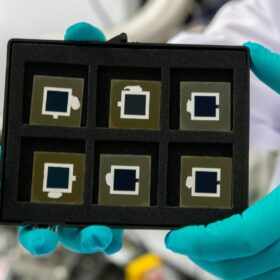
Perovskite-perovskite-silicon tandem solar cell achieves record-breaking efficiency of 27.1%
Researchers in Singapore have built a triple junction tandem solar cell with an ultrawide-bandgap perovskite absorber integrating cyanate (OCN) ions. The cell surpassed the power conversion efficiencies previously reported for all other perovskite-based triple-junction tandems, as well as single-junction perovskite and silicon solar cells.
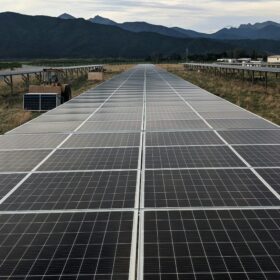
Chinese PV Industry Brief: Huaneng buys $0.12/W modules in 10 GW tender
Huaneng Group has selected eight manufacturers – JA Solar, JinkoSolar, Huayao PV, LONGi, Tongwei, GCL SI, Risen, and Huasun – for its latest PV module procurement exercise.

European Parliament, Council reach provisional agreement on forced labor
The European Parliament and European Council have reached a provisional agreement on forced labor, in order to ban products made with forced labor from the European Union, pending parliamentary approval. Member countries will have three years to enforce the new provisions.
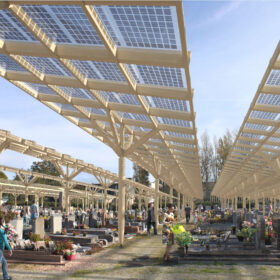
French energy associations installing solar shades above cemetery
Brier’energie and RECIT are installing solar shades above a cemetery in Saint-Joachim, northern France. The installation will span 8,000 square meters and is designed for self-consumption.
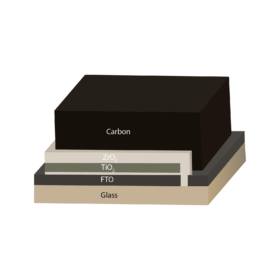
First attempt to build perovskite solar cell based on ionic liquids delivers 13.8% efficiency
North Korean researchers have designed a perovskite solar cell with an absorber treated with ionic liquids. The device reportedly offers improved passivation and fewer recombination losses.
