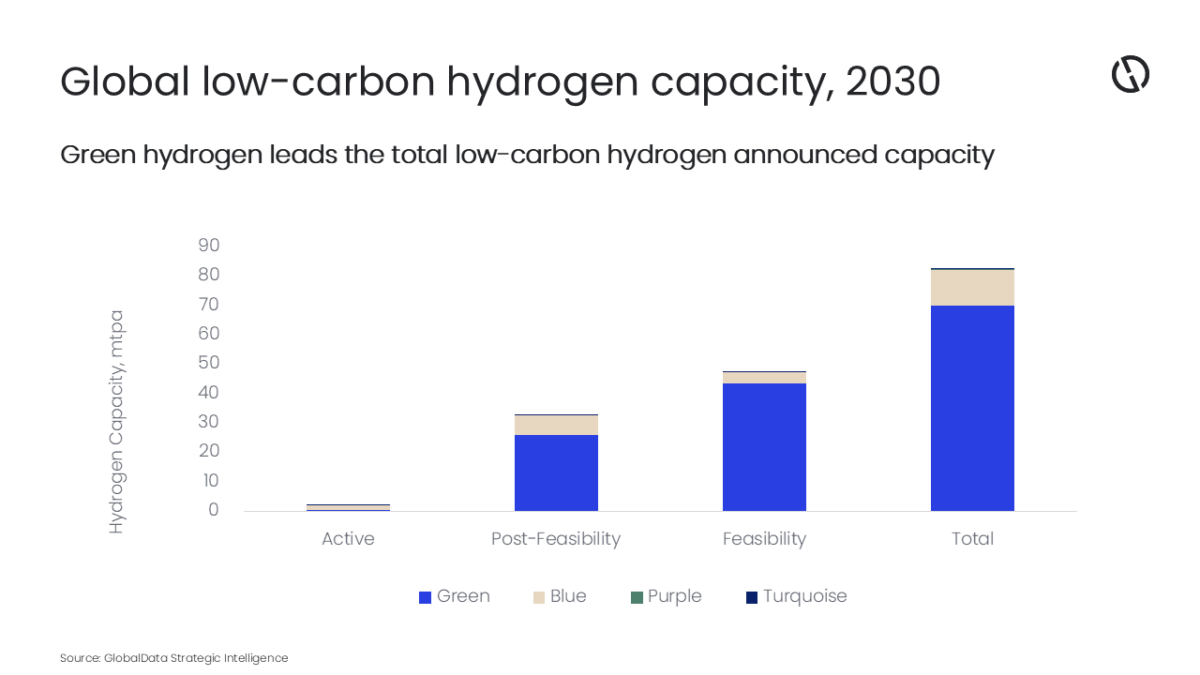





GlobalData said uncertainty around demand, financing constraints, and execution risks are shaping the pace of low-carbon hydrogen deployment, despite a growing project pipeline. In its “Hydrogen in Oil and Gas” report, the analytics firm said active low-carbon hydrogen capacity stood at about 2.2 mtpa as of February 2026, across more than 460 projects, up from 104 in 2020. It said total global hydrogen production capacity could reach 82.3 mtpa by 2030, although only about 2% of that capacity is currently operational, with 26% tied to advanced-stage projects and 57% still in feasibility. Most projects remain small-scale, with only 10 of 2,335 planned projects exceeding 1 mtpa.
Topsoe said it has terminated supply agreements with First Ammonia following missed project milestones, after extending deadlines multiple times at the developer’s request. The companies had collaborated since 2022 and signed agreements in 2024 covering 100 MW of solid oxide electrolysis cell (SOEC) electrolyzer modules for a green ammonia project in Texas. Topsoe said it is conducting a review of the industrial scale of its SOEC technology, expected to conclude by the end of the second quarter of 2026, and confirmed it remains committed to a separate 50 MW offtake agreement with Forestal.
Kyocera said it has developed two hydrogen-related components with the Japan Aerospace Exploration Agency (JAXA), including hermetic seal connectors capable of handling currents of 100 A and 110 A in liquid hydrogen environments. The company said the components passed durability and hermeticity tests at JAXA’s Noshiro Rocket Testing Center and described them as the first high-current-compatible current feedthrough terminals for such applications.
Ceres said it is collaborating with Centrica to accelerate deployment of its solid oxide fuel cell (SOFC) and SOEC technologies for distributed energy applications. UK-based Ceres Power Holdings said the partnership targets sectors including data centers, manufacturing, and logistics, with systems capable of operating on natural gas today and transitioning to lower-carbon fuels such as hydrogen and biogas.
This content is protected by copyright and may not be reused. If you want to cooperate with us and would like to reuse some of our content, please contact: editors@pv-magazine.com.

By submitting this form you agree to pv magazine using your data for the purposes of publishing your comment.
Your personal data will only be disclosed or otherwise transmitted to third parties for the purposes of spam filtering or if this is necessary for technical maintenance of the website. Any other transfer to third parties will not take place unless this is justified on the basis of applicable data protection regulations or if pv magazine is legally obliged to do so.
You may revoke this consent at any time with effect for the future, in which case your personal data will be deleted immediately. Otherwise, your data will be deleted if pv magazine has processed your request or the purpose of data storage is fulfilled.
Further information on data privacy can be found in our Data Protection Policy.