
Cayman Islands qualifies six bidders for 22.5 MW solar-plus-storage tender
A request for proposals from six qualified bidders interested in developing a 22.5 MW solar-plus-battery project is now live in the Cayman Islands. The project will be the islands’ largest solar site to date and first to integrate battery storage.

Pakistan’s largest battery storage project nears operation for cement firm
Lucky Cement’s 22.7 MWh battery is the largest in Pakistan, and the project is now just months away, according to a company executive.

Superdielectrics unveils Faraday 2 battery as a polymer-based alternative to Li-ion
Superdielectrics launches the Faraday 2 battery, advancing a water-based, metal-free approach to home storage, from a UK-based facility.

Massive solar project progresses ahead of schedule in Philippines
More than half of the first phase of the 3.5 GW solar and 4.5 GWh battery storage MTerra Solar project in the Philippines is now complete, eight months after its groundbreaking. The 778 MW of solar installed so far makes it the largest solar installation in the country.
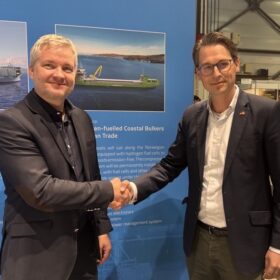
The Hydrogen Stream: eCap Marine to supply fuel cells for marine vessels
eCap Marine says it will supply 8 MW of hydrogen fuel cell systems for four zero-emission vessels under construction for Norway’s Møre Sjø and logistics firm Samskip, with deliveries expected in 2027.

CATL lawsuit threatens Hithium IPO
China’s Contemporary Amperex Technology Co. Ltd. (CATL), the world’s largest battery manufacturer, has filed a lawsuit accusing fast-growing rival Hithium of unfair competition – a move that could jeopardize Hithium’s upcoming initial public offering (IPO) in Hong Kong.
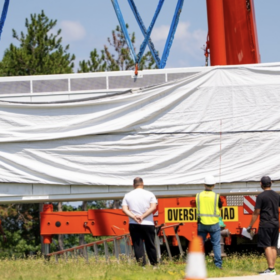
Tesla deploys 9.6 GWh in Q2, Nevada cell plant nears completion
Tesla deployed 9.6 GWh of battery storage in the second quarter of 2025, with year-to-date volumes up nearly 50% from 2024. The company recorded flat quarterly growth and says its 10 GWh Nevada cell factory is close to completion.
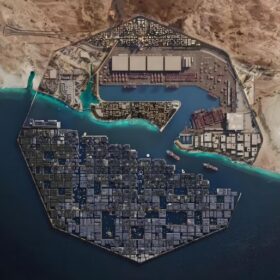
‘Grid-forming technology is no longer experimental – it’s here and working’
In grids increasingly dominated by renewables, grid-forming technology is emerging as critical tool for maintaining stability and ensuring reliable power system operation. In this interview with ESS News, Rui Sun, Sungrow’s Deputy General Manager-Grid Technology Center, explains how grid-forming works, why it matters, and where the technology is already proving its value. He elaborates on technical challenges, regulatory gaps, and why grid-forming could soon become the new industry standard.
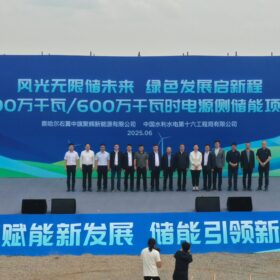
PowerChina breaks ground on world’s largest power generation-side battery storage project
On June 26, the construction of the world’s largest power generation-side energy storage project in Ulan Chab, Inner Mongolia, officially began. This 1 GW/6 GWh project, using lithium iron phosphate (LFP) technology, aims to enhance grid stability and support China’s renewable energy transition.

Researchers identify optimal level of solar, battery storage for European energy market
Researchers in Hungary have developed a model to calculate the optimal PV and battery storage balance to support the European grid in the next few years. They found that the cost-optimal range is at 530–880 GW of PV, combined with battery storage equivalent to 2.5–7.5% of the total intermittent capacity.
