
Historic icons, modern energy: Why heritage buildings need solar roofing
Heritage buildings face mounting pressure to cut carbon emissions, but traditional solar panels often clash with their historic appearance and face public resistance. Building-integrated photovoltaics (BIPV) offer a discreet alternative, blending solar technology into roofing materials and enabling wider adoption across protected sites. As UK policy increasingly supports solar on historic buildings, BIPV presents a scalable solution that reconciles climate action with architectural preservation.
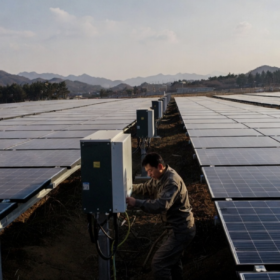
South Korean solar inverter industry raises cybersecurity concerns
South Korean solar inverter makers have jointly launched a new association of inverter manufacturers to coordinate domestic production, safeguard local expertise, and address import-driven market issues and grid stability challenges.

Chinese PV Industry Brief: January-October solar additions reach 252.87 GW
China’s National Energy Administration (NEA) says developers installed 252.87 GW of new PV capacity from January to October 2024, including 12.6 GW in October alone.

Atlantic Storm Claudia cuts solar irradiance across Western Europe
In a new weekly update for pv magazine, Solcast, a DNV company, reports that Storm Claudia significantly reduced daily irradiance across the British Isles and the Iberian Peninsula, limiting solar generation.
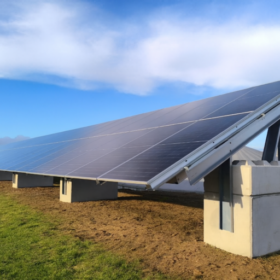
French startup offers modular, demountable ground-mounted solar systems
Enowatt says its modular, demountable photovoltaic structures allow companies to deploy solar capacity on existing sites without major building reinforcement, using ballasted units that install directly on asphalt.

Spain’s Sumcab launches new cables for PV installations
Spanish manufacturer Sumcab says its new ToughGround and Overground cables are designed for underground and overhead photovoltaic systems throughout the world, offering durability, rapid installation, and a 30-year lifespan.

Austria deploys 1 GW of PV in January-September period
Austria added 1,036 MW of new solar capacity between January and September 2025, down from 1,419 MW over the same period in 2024, as political uncertainty, delayed legislation, and weakening residential demand strain the solar sector.
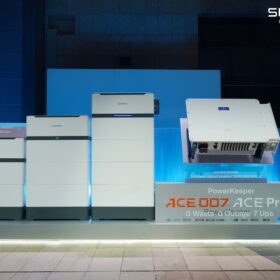
Sungrow unveils new modular C&I battery with long-duration storage capability
The new 12.5 kWh pack-based design supports flexible configuration up to 250 kWh per system. An optional long-duration combiner box supports 2–4 clusters, expandable to 1,000 kWh and 8 hours of storage.

Palestine Investment Fund provides update on solar deployment in Jerusalem
A financing program run by the Palestine Investment Fund and European Union has helped to install solar systems at Jerusalem-based companies and projects, leading to annual electricity cost savings of around €250,000.
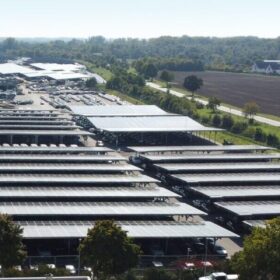
German developer commissions nation’s largest solar carport
Germany has brought a 17 MW photovoltaic carport online in Riedstadt, Hesse, spanning 76,000 square meters. It is expected to generate about 17 GWh per year, according to project developer Nawasol.
