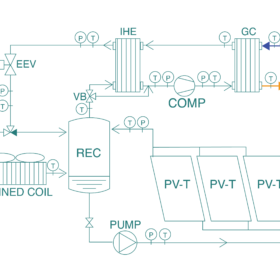
Dual-source CO2 heat pump based on photovoltaic-thermal evaporators
Researchers in Italy have conceived a dual-source heat pump system that uses both a finned-coil evaporator and a solar evaporator made with three photovoltaic-thermal panels. Thanks to the combined action of the two evaporators, the heat pump can achieve higher evaporation pressure and coeffficient of performance.

Platio debuts new walkable solar panels
The Hungarian company said its new products can handle a load of 300 kg. The modules are available with power outputs of 23.65 W and 59.68 W and can be integrated with wood-plastic composite, wood, stone, or ceramic floorings.
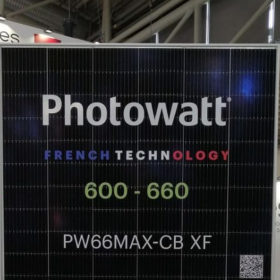
Carbon acquires Photowatt
Carbon has acquired Photowatt and says it will invest €40 million ($44.6 million) to support its activities.

Computer vision for real‑time shadow detection in PV systems
Scientists have developed a novel method that uses live video feed to detect shadows on solar panels. It uses computer vision techniques, such as gamma transform and histogram matching, resulting in performance that is reportedly better than conventional techniques, especially in large arrays.

Longi, ANU develop gettering-based process to improve n-type wafer quality
The Chinese module maker and the Australian National University utilized phosphorus diffusion gettering and another defect mitigation strategy to improve the quality of n-type wafers. The proposed process contributed to improve the material quality especially towards the tail-ends.
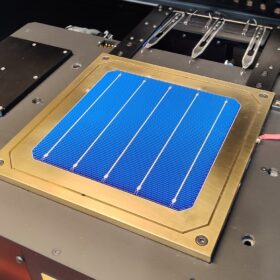
Chinese PV Industry Brief: JP-Solar, Golden Solar, Longi create PV venture
Golden Solar New Energy Technology says its subsidiary, Golden Solar (Quanzhou), has started a CNY 659 million ($93.4 million) joint heterojunction (HJT) solar venture with Longi and JP-Solar Power.
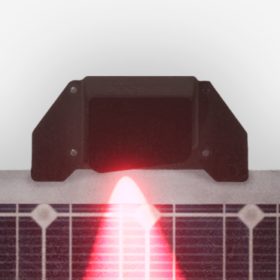
Sun-X secures patent for PV sensor that measures soiling, yield loss
Germany-based Sun-X says it has patented a soiling sensor for PV modules that accurately measures dirt levels, determines yield loss, and assesses optimal cleaning times.

Italian energy supplier to reuse discarded PV modules for social projects
Italian energy producer ERG has launched an initiative to reuse discarded solar modules from revamped plants for social solar projects. The program aims to support communities, hospitals, families, and schools in Africa and Italy, using panels that are still in good condition and fully functional.

Vertical PV comes to India
Yashika Energy Systems has partnered with Germany’s Next2Sun and Wattkraft India to launch pilot projects that integrate vertical bifacial solar technology with agriculture, ranging from 100 kWp to 500 kWp.

EU-funded project seeks set up pilot production of large-area perovskite PV modules
The EU-funded Laperitivo project aims for 22% efficiency in 900 cm² opaque perovskite modules and 20% efficiency in semi-transparent ones. The project partners include imec, Fraunhofer ISE, TotalEnergies, and EDF.
