
INA Solar breaks ground on 3 GW solar panel factory in India
Insolation Energy (INA Solar) is building a 3 GW PV module factory and aluminum frame plant in Rajasthan, India.

France’s Carbon reveals plans to acquire Photowatt
Carbon, a French PV module maker, has revealed plans to acquire panel manufacturer Photowatt, which is a unit of French energy giant EDF.

DYCM Power announces $800 million US solar cell, module factory
DYCM Power says it will build an $800 million solar cell and module factory in the United States, starting with 2 GW capacity and plans to expand to 6 GW.
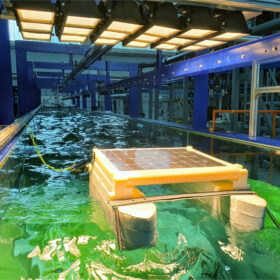
Scientists create setup to measure wave-induced power losses in floating PV
Researchers have measured the power loss of a 50 W panel stationed in a 30-meter wave tank. Based on ten different scenarios, they were able to draw an empirical equation for the prediction of power loss, with the highest loss being measured at 12.7%.
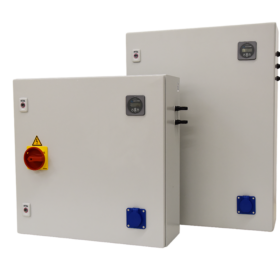
Solar cabinet for water disinfection systems
German fluid management company Lutz-Jesco introduced a system aimed at supporting pumping and water disinfection in cases of blackouts. The hub is preconfigured to work with solar panels, a battery charge controller, an inverter, and cabling.
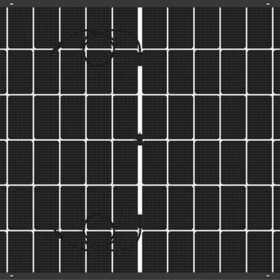
Sharp launches 450 W bifacial TOPCon module with 22.52% efficiency
Sharp’s new IEC61215- and IEC61730-certified solar panels have an operating temperature coefficient of -0.29% per C and a bifaciality factor of over 80%.
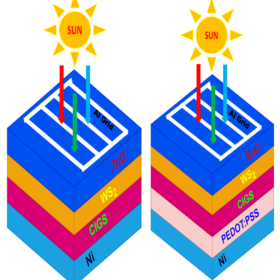
Ultrathin CIGS cell based on tungsten disulfide promises 25.7% efficiency
The novel solar cell uses tungsten sulfide as the back surface field layer. According to its creators, this layer can be included in conventional CIGS solar cells to improve their efficiency and reduce the absorber material’s cost.
Inside solar panel decommissioning
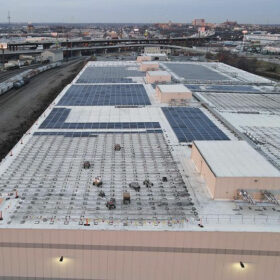
The practical matter of taking a dead PV system apart and moving its components to their next destination has received less attention than recycling and second-life applications. In the United States, Decom Solar is offering decommissioning for commercial and industrial (C&I) solar projects. pv magazine spoke to Decom Solar co-founder Stephen Burns for an update.

Scientists design all-back-contact transparent solar cell
A research team from South Korea’s Ulsan National Institute of Science & Technology (UNIST) has designed a wire-free transparent solar cell and module with all electrical contacts placed on the rear side. A 16 cm² module achieved a power conversion efficiency of 14.7% and successfully charged a smartphone using natural sunlight.

Paxos Solar unveils glass-glass PV tile with heat pump integration
Paxos Solar has developed a new glass-glass PV tile that integrates with heat pumps, featuring Longi’s back-contact solar cells. The 44 W, 59.5 cm x 48 cm tile can also produce heat for residential systems.
