
Chinese PV Industry Brief: JinkoSolar, Longi, Trina Solar, JA Solar post Q1 losses
China’s leading solar manufacturers all reported first-quarter net losses, despite improving margins and continued high shipment volumes across the sector.
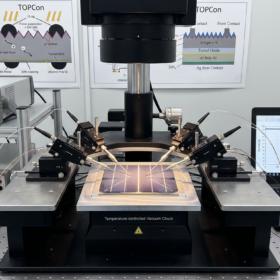
New research uncovers interface-level physical mechanisms driving UV degradation in TOPCon solar cells
New research from China reveals that ultraviolet degradation in TOPCon solar cells is governed by interface-level physical mechanisms involving hydrogen dynamics, defect formation, and charge evolution. These processes are strongly influenced by the design of the silicon nitride/aluminum oxide passivation stack, which determines long-term device stability.
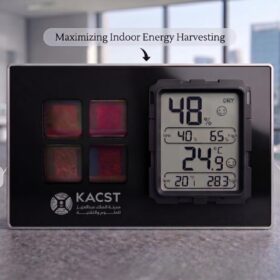
Bandgap-engineered indoor perovskite solar cell achieves 37.44% efficiency
An international research team has improved the performance of perovskite indoor photovoltaics by tuning the absorber bandgap to better match the emission spectrum of indoor LED lighting. The approach enables improved spectral alignment under low-light conditions, with devices demonstrating efficiencies of up to 37.44% alongside long-term stability exceeding 2,000 hours.
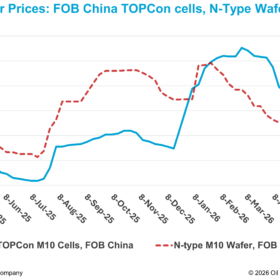
China TOPCon solar cell prices stabilize as holiday lull slows trading
In a new weekly update for pv magazine, OPIS, a Dow Jones company, provides a quick look at the main price trends in the global PV industry.
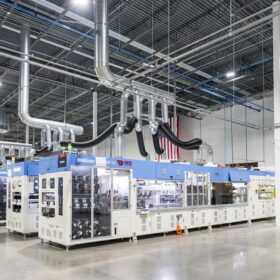
SEG Solar to expand U.S. manufacturing with 4 GW solar module plant
The $200 million investment will bring the company’s total domestic production capacity to 6 GW by late 2026.

Sonnenkraft launches 480 W back-contact TOPCon solar module
The Austrian manufacturer said its new glass-glass module features 108 back-contact TOPCon half-cells and a power conversion efficiency of 23.52%.
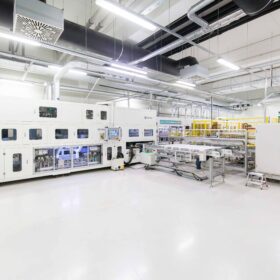
Inside PV Manufacturing: SoliTek’s new fully automated module line in Lithuania
In the latest article of a new series on solar manufacturing facilities around the world, pv magazine presents SoliTek’s solar manufacturing facility in Vilnius, Lithuania. The company recently commissioned an upgraded 200 MW production line, as it transitions from semi-automated to fully-automated processes for critical assembly stages.

Autonomous photovoltaic vehicle Infinite Apollo validates urban circulation performance
In late April, a 200 km urban road test was conducted in Belgium under real-world traffic conditions and varying levels of solar irradiance to evaluate system performance in complex operational environments. The test serves as the final validation of the vehicle’s systems.
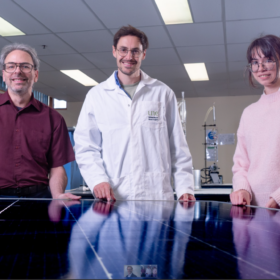
Australian researchers accelerate silicon wafer recycling using AI, robotics
Scientists from the University of New England’s Australian Institute for Strategic Artificial Intelligence are using artificial intelligence and powerful supercomputers to assess potential solvents to separate silicon wafers with minimal contamination.
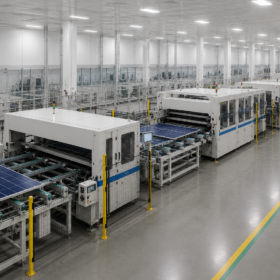
Texas PV module production to exceed 15 GW in 2026
Propelled by a select group of high-capacity manufacturers including T1 Energy and Canadian Solar, Texas is set to exceed 15 GW of solar PV module production in 2026, accounting for nearly half of all U.S. silicon-based manufacturing and serving as the primary hub for the inaugural Solar Manufacturing USA conference in Austin this September.
