
Korean startup developing perovskite-CIGS tandem solar technology for satellites
Flexell Space is planning to put its perovskite-copper indium gallium selenide (CIGS) tandem solar cell technology in-orbit later this year. It has also raised venture capital and signed several collaboration agreements, including a technology transfer with the Korea Institute of Energy Research.

Websol to expand solar cell, module capacity by 4 GW
Websol Energy System Ltd has approved the addition of 4 GW of solar cell and module manufacturing capacity, with a total investment of INR 3,000 crore. The manufacturer said the new cell capacity will be based on TOPCon technology.

Weathered PV backsheets have 46% faster flame spread than unweathered counterparts
Researchers in Singapore have accelerated the weathering of PV backsheets and investigated their flame spread behavior at different intervals. After 6 weeks, they found that weathered PV backsheets show 46% faster flame spread than unwearthered ones. They have also highlighted that current safety standards fail to account for long-term degradation.

All back-contact perovskite solar cell designs at a glance
Scientists from Japan, Saudi Arabia and the United States have investigated existing back-contact perovskite solar cell architectures and have proposed a strategy to help reach commercial production.
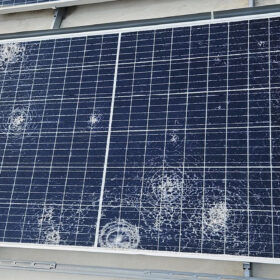
New hail test aims to more accurately measure solar panel resilience
A new test curve for determining solar panels’ breaking point from hail uses a broader spectrum of impact energies and testing products.

Finnish glass maker offers PV systems integrated into glass balcony parapets
Finland-based Lumon has integrated balcony PV modules into a glass parapet, maintaining the facade’s appearance without visible technical components. The first project using the product has already been completed in Finland.

Chinese manufacturer plans solar glass factory in Algeria
China’s Kibing Group is looking to develop a solar glass manufacturing facility in Algeria with an annual production capacity of 1.53 million tonnes.

Holosolis signs TOPCon patent licensing agreement with Trina Solar
HoloSolis is currently planning to open a 5 GW PV cell and panel factory in Hambach, France.
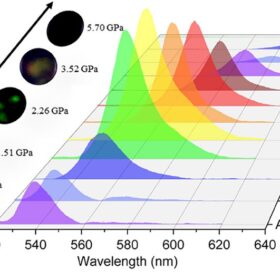
Finetuning 2D Dion-Jacobson perovskites for photovoltaic applications
Canadian and U.S. researchers have investigated applying pressure to a 2D hybrid organic-inorganic perovskite to tune the optical and electronic properties to suit photovoltaic applications, light emitting diodes or other semiconductor devices.
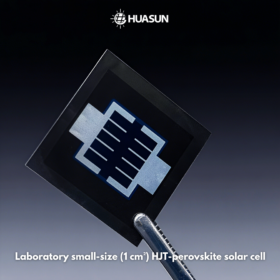
Huasun achieves 34.02% efficiency for perovskite-heterojunction solar cell
The Chinese manufacturer said the result was achieved thanks to new perovskite crystallization additives and high-mobility carrier transport layer materials.
