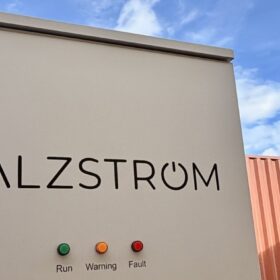
Austria’s Salzstrom unveils sodium-ion storage system for commercial applications
The new SALT 110 battery storage system from the Vienna-based company has a usable capacity of up to 110 kWh. The storage system is reportedly capable of 6,000 charge cycles at a depth of discharge of 95%.
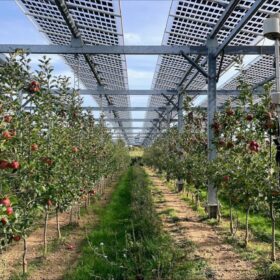
New solar tracking strategies aim to maximize crop yield in agrivoltaics
Swedish researchers developed two novel single-axis solar tracking strategies that dynamically adjust panel tilt based on crop light requirements, balancing photosynthesis and energy production. One strategy prioritizes daily light integral targets before shifting to energy capture, while the other uses the light-response curve to optimize photosynthesis, offering improved dual-use efficiency compared with conventional tracking methods.
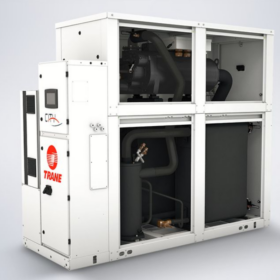
Trane presents high-temperature water-to-water heat pump
The Irish heating specialist has launched a high-temperature heat pump delivering up to 110 C hot water and heating capacities of 100 kW to 370 kW for industrial and district heating applications. The system achieves a coefficient of temperature of up to 4.63.

German startup launches gateway to block inverter kill switches
German startup Solarsecure Tech has introduced a gateway designed to decouple PV inverters from manufacturer clouds and block unauthorized remote control commands.

SolarPower Europe issues due diligence guide for PV-BESS
SolarPower Europe has released new technical due diligence guidelines for utility-scale solar-plus-storage projects, covering risk, engineering and lifecycle standards for co-located PV and battery systems.

Fraunhofer IEE calls for ‘grid-forming readiness’ in distribution networks
Germany’s Fraunhofer Institute for Energy Economics and Energy System Technology IEE (Fraunhofer IEE) says in a new position paper that large-scale battery storage systems in medium-voltage grids should be technically prepared for future grid-forming operation, aiming to bridge the gap between current regulations and potential system stability requirements.

AlphaESS releases containerized C&I storage system
The Chinese manufacturer said its Aster TB250/TB500 system is compatible with both 40 0V and 800 V PV systems. Parallel connection allows scaling up to 3 MW / 8.46 MWh.

Standardizing smart energy requirements
A systems approach is essential for smart energy standardization, ensuring interoperability, avoiding overlaps, and addressing complex interactions across the grid, appliances, and infrastructures. The IEC System Committee for Smart Energy (SyC SE) applies system-level thinking, using tools like reference architectures and roadmaps to coordinate standards, support innovation, and tackle emerging areas such as EV integration, digital twins, and zero-emission technologies.
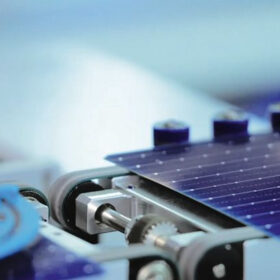
JinkoSolar achieves record-breaking 26.66% efficiency for TOPCon solar cell based on M10-size wafer
The Chinese manufacturer claims the new efficiency result sets a world record for industrial-scale TOPCon solar cells on M10-size wafers. The achievement was verified by an undisclosed independent third-party organization in China.
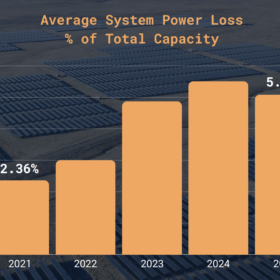
US solar assets lose average $5,070 per MW from power losses
A new report calculates the average power loss of 373 GW of utility-scale and commercial and industrial solar assets in the U.S. at 5.08%, more than double the level five years ago. The power loss average among projects deploying robotics and automation falls to 3%.
