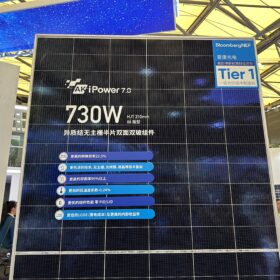
Akcome unveils new 730 W heterojunction solar modules
Chinese manufacturer Akcome has released a new line of heterojunction solar panels with a nominal power capacity ranging between 710 W and 730 W and a conversion efficiency of 22.80% to 23.50%.
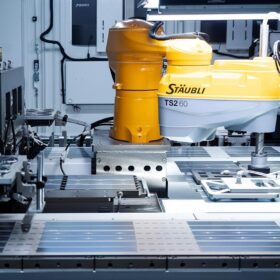
Chinese PV Industry Brief: TW Solar plans 20 GW module factory in Sichuan province
TW Solar announced it will invest around $1.48 billion in a new integrated solar module manufacturing facility in Chengdu City. Meanwhile, Jinkosolar began to buy new production equipment for its expansion plans from Wuxi Autowell.
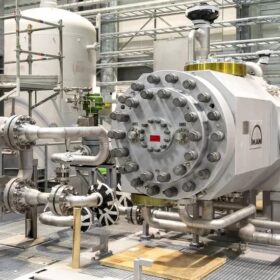
MAN Energy installs world’s largest seawater CO2 heat pump in Denmark
Germany’s MAN Energy Solutions has supplied two 50 MW seawater heat pumps for district heating at the port of Esbjerg, Denmark. They use CO2 as a refrigerant and will be powered by nearby wind farms. The project will start producing 350,000 MWh of heat per year in the fall.
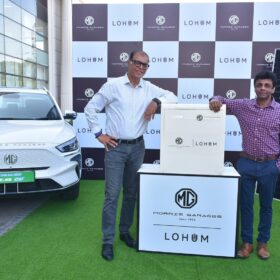
Indian startup introduces 5 kWh storage system based on second-life EV battery
India’s Lohum has designed a 5 kWh energy storage system in collaboration with MG Motor India, as part of efforts to develop second-life solutions for used EV batteries.
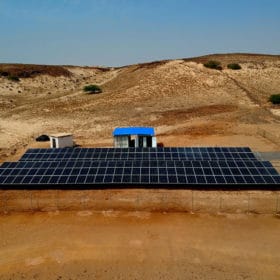
Bangladesh introduces fiscal breaks for solar-powered water desalination
Bangladesh has introduced tax exemptions to reduce water production costs and promote the use of solar power in 19 coastal districts. This initiative comes in response to grid electricity shortages caused by a decline in coal and fuel imports. The goal is to enhance reliance on solar-powered water desalination in these areas.
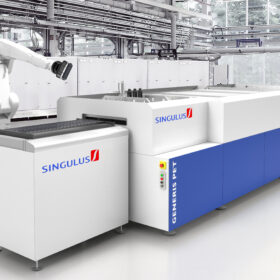
Singulus claims new coating machine can improve PV cell efficiency up to 1%
Singulus says its new production equipment can apply a passivation layer to the edges of half-cell, multi-cell, and shingle cells. Its Generis PET machine is also suitable for batch or inline processing and is compatible with all crystalline solar cell technologies.
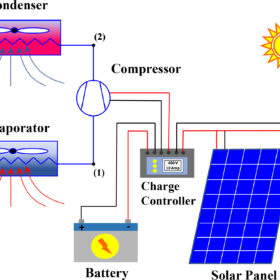
PV-powered offgrid air conditioner for building applications
A British research team has investigated the technical feasibility of an air conditioning unit powered exclusively by solar-plus-storage and has found that two 130 Ah batteries charged by two 400 W solar panels are capable of supporting the system during the night.
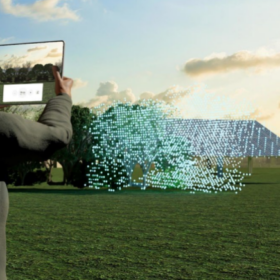
French agrivoltaics specialist uses AI for landscape integration
France’s GLHD uses AI tech for landscape integration through a tablet app that displays and visualizes fixed structures at agrivoltaic farms.
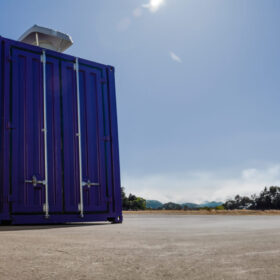
Australian startup unveils 100 kW hydrogen power bank
Endua has installed its first 100 kW standalone hydrogen power bank in Brisbane, Australia. The news comes weeks after the company raised AUD 11.8 million ($7.81 million) to scale the technology.

US researchers beam solar from space
Caltech’s space solar program began in 2011 when philanthropist Donald Bren donated more than $100 million in support of the project. In the first demonstration of solar energy beamed to earth, his vision is now becoming reality.
