
Amelia Hub unveils all-in-one solution for pile-driving and tracker installation
The Spanish company has launched the Hincator, a device that precisely measures key pile parameters, and Amelia Solar, a cloud platform that processes data in real time, to ensure pile-driving and trackers in PV plants are installed correctly and within project tolerances.
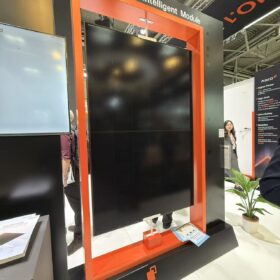
Aiko unveils back-contact solar module with ‘fully intelligent integration’
Chinese solar cell and module maker Aiko presented its new intelligent solar module series, Navigator, at this year’s Intersolar. Based on the company’s N-type, all-back-contact (ABC) technology, Navigator promises a 3% to 5% boost in annual energy yield and lower operating costs.

Eturnity adds more PV design automation, energy system project control to its software
Additional project management and design automation tools are available on the Swiss software company’s subscription-based platform made for small and medium-sized (SME) businesses that are targeting commercial and industrial (C&I) and residential the solar PV segments.

FuturaSun, TNO sign bifacial solar cell collaboration
FuturaSun and The Netherlands Organization for Applied Scientific Research will work together on advancing the design of bifacial n-type silicon solar cells, with the technology to be integrated into FuturaSun’s Silk Nova solar modules.

TCL SunPower launches back contact solar modules
The SunPower M Class product portfolio offers solar panels for the residential and commercial markets featuring the company’s latest back contact solar technology. The panels are expected to reach 25% efficiency for residential applications up to 500 W and 24.4% for commercial applications up to 660 W.
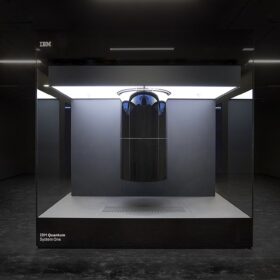
Quantum-based energy management method for PV-powered buildings
Scientists from Cornell University combined quantum computing with model predictive control to manage the energy of two PV-equipped university buildings. Compared to deterministic approaches, the quantum strategy achieved a 6.8% improvement in energy efficiency and an annual reduction of 41.2% in carbon emissions.
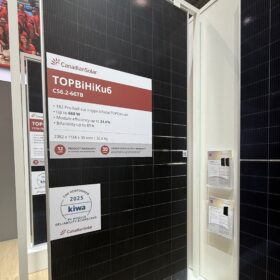
Canadian Solar debuts 660 W TOPCon solar panel with 24.4% efficiency
The new products are available in seven versions with power output ranging from 630 W to 660 W and power conversion efficiency spanning from 23.3% to 24.4%.
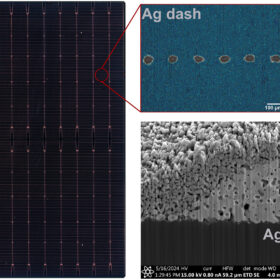
Silver-lean screen-printing can reduce silver use in TOPCon solar cells by 40%
An international research team has developed a metallization technique for TOPCon solar cells that can reportedly reduce silver usage in the devices’ rear side by 85%. The scientists replaced the commonly used Ag fingers with intermittent Ag dashes for contact formation and Ag-free fingers and busbars for electrical conduction.
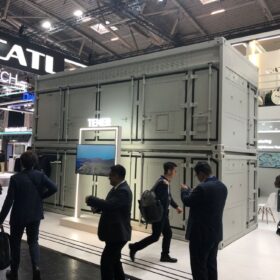
CATL unveils 9 MWh utility-scale battery
The world’s biggest battery maker unveiled its latest utility-scale battery energy storage product- the Tener Stack – at the Smarter E show. The 9 MWh system supports both centralized and string power conversion system architectures, offering flexibility for a range of deployment scenarios.
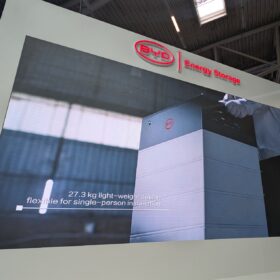
BYD launches new residential battery
BYD has launched its new Gen4 home battery known as HVB, and is expected to be a popular addition to the residential storage space.
