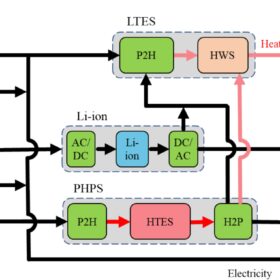
How to integrate solar-plus-storage with heat pumps
Scientists in Spain have simulated a system that uses both power-to-heat-to-power thermal batteries and lithium-ion batteries for energy storage. The hybrid system reportedly achieved a 7% lower LCOE compared to a PV system relying solely on lithium batteries, while simultaneously increasing PV self-consumption by up to 20%.

Takamiya launches vertical mounting solution for agrivoltaics, areas with little space
The Japanese company said its new vertical mounting system is ideal for farmland, regions with heavy snowfall, along factory fences, and in parking areas.
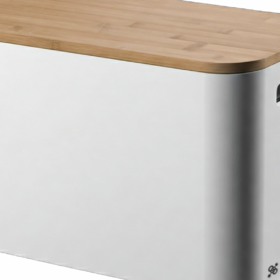
FlexHome Energy offers home battery in utility-sharing deal
A new product from German supplier FlexHome Energy could offer residents without a solar array, such as apartment dwellers, the chance to make electricity savings and strengthen the grid.

ZTT debuts 7.58 MWh liquid-cooled battery storage system
The Energrid NA7 incorporates ZTT’s self-developed 3S-integrated power conversion system (PCS) and supports 2000 V high-voltage DC input.
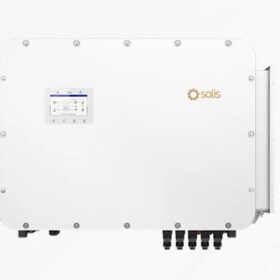
Solis launches new hybrid inverters for C&I solar
The Chinese manufacturer said its new product is the world’s largest wall-mounted hybrid inverter. The series includes three models, with AC outputs of 80 kW, 100 kW, or 125 kW.

Fraunhofer ISE streamlines use of epitaxial wafers in TOPCon solar cell manufacturing
Researchers at the German research institute have demonstrated that the so-called EpiWafers could be used directly for solar cell fabrication without needing a pre-gettering step. Their experiments provide a proof of principle* for epitaxially grown silicon wafers from German wafer manufacturer NexWafe GmbH.

Low residential solar feed-in tariffs can encourage battery deployment
Analysis of feed-in tariff scenarios in Central and Eastern Europe finds that while high feed-in tariffs are linked to the adoption of residential solar, lower tariffs are more likely to encourage battery installations. The study proposes a moderately low range of tariffs as one compromise to support both technologies.

Vikram Solar launches 630 W n-type bifacial modules
The Indian solar manufacturer has launched its Hypersol series panel series with power output from 605 W to 630 W and efficiency between 22.38% and 23.30%.
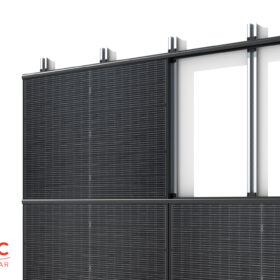
IBC Solar launches mounting systems for rooftop, facade PV systems
Germany’s IBC Solar has developed two new mounting systems for rooftop and facade PV installations: the WallFix system, made of aluminum and stainless steel, and the AeroFix G3.1, designed for modules up to 3 square meters.
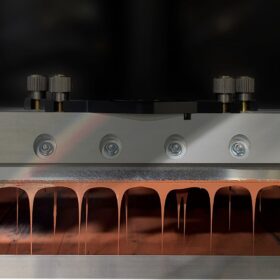
U.S. startup offers new solar cell copper metallization paste
Bert Thin Films has developed a copper paste for solar cell manufacturing that keeps the copper from oxidizing during the air-firing process while at the same time avoiding it to make direct contact with the silicon. The new product can be used in existing production lines and with different cell configurations.
