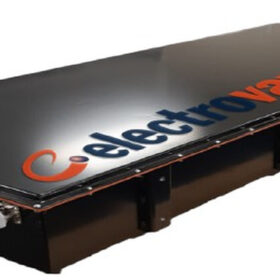
Electrovaya unveils battery tech for high voltage applications, stationary energy storage
The Canadian battery manufacturer offers the product in two versions with a nominal energy of 35 kWh and 70 kWh, respectively. It claims a projected 25-year lifetime for one-cycle per day applications.
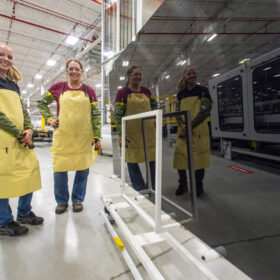
First Solar announces fifth US factory
First Solar has revealed plans to open its fifth factory in the United States. The new facility is expected to add 3.5 GW of annual production capacity at a cost of $1.1 billion.
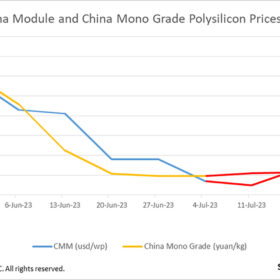
Module prices revert to descending trajectory after a brief rally
In a new weekly update for pv magazine, OPIS, a Dow Jones company, provides a quick look at the main price trends in the global PV industry.
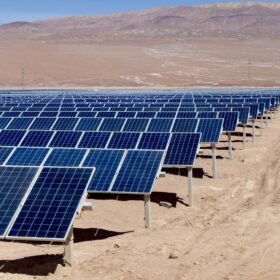
AES switches on 180 MW PV plant linked to 112 MWh of storage in Chile
AES Corp. has switched on a 180 MW solar plant connected to 112 MWh of storage in Chile. The project in the Atacama Desert is Latin America’s largest solar plant to be linked to battery storage.
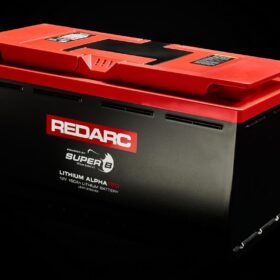
Redarc unveils 150 Ah lithium battery
The Alpha 150 battery, produced in the Netherlands by Australian electronics manufacturer Redarx, has a lifespan of more than 5,000 cycles and a continuous discharge rating of 200 A.

Greece’s PV fleet keeps power system running during heatwave
Greece is experiencing consecutive heatwaves and a number of forest fires this month that have increased demand for electricity. The country’s solar photovoltaic fleet is keeping the power system running at peak times.
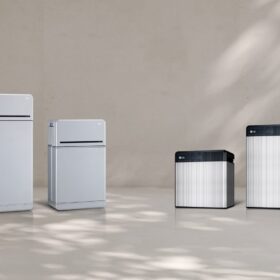
LG launches residential hybrid inverters for European market
South Korea’s LG Energy Solution says its new hybrid inverters are suitable for high-voltage and low-voltage configurations.
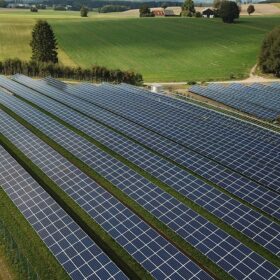
PPA prices fell 11% in Europe in May, says Pexapark
Pexapark says that prices for power purchase agreements (PPA) fell 11% in Europe in May. Germany and Spain were the largest markets for PPAs, with deals totaling 245 MW and 317 MW, respectively.
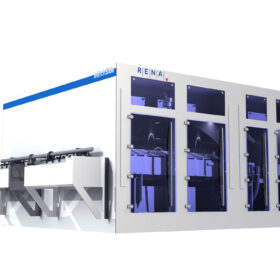
RENA announces 1.8 GW sale for new TOPCon equipment
German company RENA Technologies has announced the first sales of a new tool for silicon cell manufacturing. The tool is used for etching/removal of unwanted material on one side of a solar cell, and will be integrated into the gigawatt-scale production of an unnamed manufacturer in South Asia working with TOPCon technology.
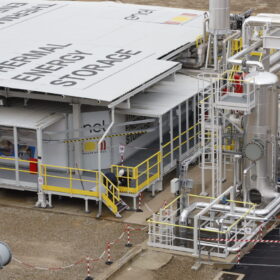
Brenmiller, Waaree Energies to deploy thermal energy storage projects in India
Brenmiller’s bGen system heat crushes rocks and then stores that thermal energy for minutes, hours, or days. The stored heat energy can be used to produce energy in the form of steam for electricity, water, or hot air for industrial applications.
