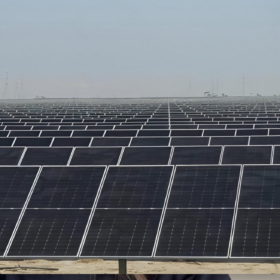
India installs record 36.6 GW of solar in 2025
India added 36.6 GW of solar capacity in 2025, up 43% from the previous year, with large-scale projects accounting for 81% of installations, according to Mercom India.

US repeals greenhouse gas endangerment ruling
The US Environmental Protection Agency (EPA) has repealed the 2009 Endangerment Finding that classified greenhouse gases as a threat to public health, removing the legal basis used to regulate carbon emissions under the Clean Air Act.

The impact of land slope on agrivoltaics feasibility
Brazilian scientists have developed a slope-based framework for agrivoltaics, finding that sites below 15% gradient offer the best balance between agricultural suitability and technical feasibility. Their review of 30 studies shows that steeper terrain can host PV systems with adapted designs, land-use limits, erosion risks, and rising installation costs.

Fraunhofer ISE, PTB report just 0.15% uncertainty in PV module yield measurements
An interlaboratory comparison between the CalLab PV Modules of Fraunhofer Institute for Solar Energy Systems ISE and Physikalisch-Technische Bundesanstalt finds the two organizations deviate by less than 0.15% when measuring the performance of photovoltaic modules. The Fraunhofer team says this is one of the most important indications as to whether their analysis is on the right track.

World’s first 628 Ah grid-scale battery enters operation
EVE Energy says a 200 MW/400 MWh battery energy storage project in China has entered operation, which it describes as the world’s first utility-scale deployment of 628 Ah lithium iron phosphate (LFP) cells.

Mibet launches universal metal roof mounting system
The Chinese supplier said the new product uses high-strength AL6005-T5 aluminum alloy and SUS304 stainless steel. It can be adjusted to a tilt angle of 0-15°.

IEC-based technical specifications needed for second-life PV module market
The latest report from the International Energy Agency’s (IEA) Photovoltaic Power Systems Programme (PVPS) says second-life PV modules have the potential to reduce waste and extend the value of solar assets, but their market today remains underdeveloped and requires advances in technical qualifications, scalable reuse infrastructure and supportive policy frameworks.

SALD launches large area sheet-to-sheet tool for perovskite solar pilot lines
The Dutch spatial atomic layer deposition equipment manufacturer has launched a new sheet-to-sheet tool for pilot production of large area perovskite solar devices on glass substrates.

Beyond first-time installations: How Europe’s residential solar Market is shifting toward upgrades and intelligent energy systems
Europe’s residential solar market is shifting from rapid rooftop PV growth to a more selective phase, with declining new installations but rising demand for upgrades like storage, smart energy management, EV integration, and balcony systems. Rather than retreating, households are reinvesting in complementary technologies that enhance flexibility, reliability, and self-consumption, redefining residential demand around integrated, intelligent energy solutions.

Spain hits 50 GW solar milestone
Spain’s installed solar capacity reached 50 GW in early 2026 after adding about 8.7 GW in 2025, according to grid operator Red Eléctrica de España (REE).
