
TCL SunPower launches back contact solar modules
The SunPower M Class product portfolio offers solar panels for the residential and commercial markets featuring the company’s latest back contact solar technology. The panels are expected to reach 25% efficiency for residential applications up to 500 W and 24.4% for commercial applications up to 660 W.

The Hydrogen Stream: Sungrow starts world’s largest dual-tech green H2 plant
Sungrow Hydrogen has started production at China’s largest dual-tech green hydrogen project combining PEM and alkaline electrolyzers, while HNO International has partnered with Zhuhai Topower to pilot its modular hydrogen platform in China.
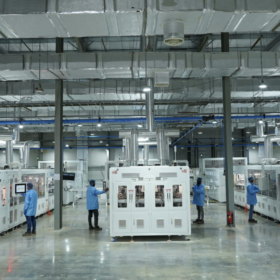
Indian solar manufacturing to hit 160 GW of modules, 120 GW of cells by 2030
India is expected to reach 160 GW of solar module capacity and 120 GW of cell capacity by 2030, up from 80 GW and 15 GW respectively in 2025, according to a new SolarPower Europe report, with input from the National Solar Energy Federation of India (NSEFI).
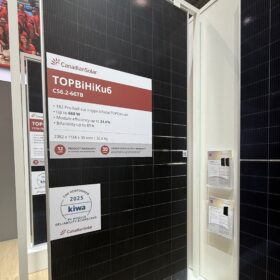
Canadian Solar debuts 660 W TOPCon solar panel with 24.4% efficiency
The new products are available in seven versions with power output ranging from 630 W to 660 W and power conversion efficiency spanning from 23.3% to 24.4%.
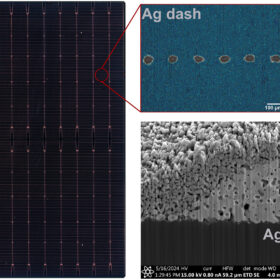
Silver-lean screen-printing can reduce silver use in TOPCon solar cells by 40%
An international research team has developed a metallization technique for TOPCon solar cells that can reportedly reduce silver usage in the devices’ rear side by 85%. The scientists replaced the commonly used Ag fingers with intermittent Ag dashes for contact formation and Ag-free fingers and busbars for electrical conduction.
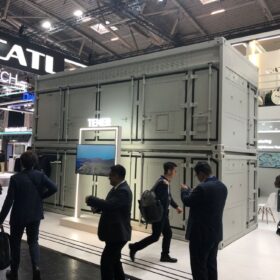
CATL unveils 9 MWh utility-scale battery
The world’s biggest battery maker unveiled its latest utility-scale battery energy storage product- the Tener Stack – at the Smarter E show. The 9 MWh system supports both centralized and string power conversion system architectures, offering flexibility for a range of deployment scenarios.
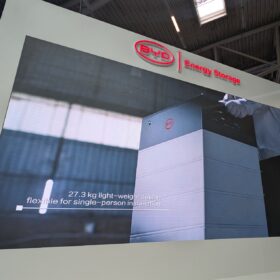
BYD launches new residential battery
BYD has launched its new Gen4 home battery known as HVB, and is expected to be a popular addition to the residential storage space.

Longi launches residential heterojunction back-contact solar module with 25% efficiency
Longi has developed the Hi-MO S10, a residential heterojunction (HJT) back-contact solar module with 25% efficiency, combining 27.6%-efficient cells with up to 510 W output and 252.3 W/m² power density.
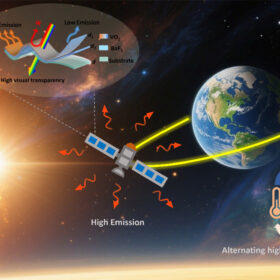
Novel smart coating for space solar cells
Researchers in China have investigated how transparent smart radiation devices (TSRD) can be used to protect space solar cells from extreme thermal fluctuations. Through a series of simulations, they have shown that the proposed technique could become an “effective” solution for spacecraft solar cell thermal management.
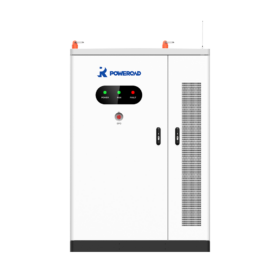
Poweroad launches 233 kWh battery for C&I solar
The Chinese manufacturer said that up to 10 battery cabinets can be connected in parallel to reach a total storage capacity of 2.33 MWh.
