
Dutch startup plans roll-to-roll factory for perovskite solar cells
TNO has launched Perovion Technologies to industrialize lightweight, flexible perovskite solar cells, targeting niche applications where conventional panels are unsuitable. The company plans to build the first roll-to-roll perovskite solar cell manufacturing facility in the Netherlands by 2030.
Netherlands hits record electricity production and exports in 2025
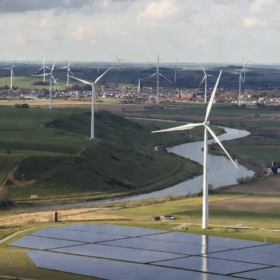
The Netherlands set a record in 2025, generating 132 billion kWh of electricity, up 10% from 2024, with renewables supplying 49% of output and exports rising 25% to 30 billion kWh.
Jackery introduces SolarVault 3 series of residential solar storage solutions in the Netherlands
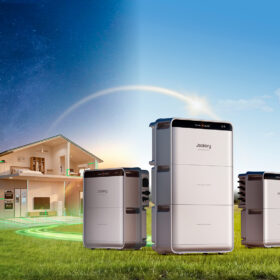
Two models in the series are designed to capture up to 4000 W of solar input with four independent MPPTs, while the third model – the SolarVault 3 Pro Max AC – is an AC-coupled solar storage solution that allows households to add battery storage without rewiring. The model is particularly suited to regions where net metering schemes are being phased out.
Photoncycle raises €15 million to launch seasonal hydrogen home storage
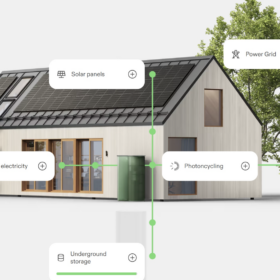
Norway’s Photoncycle has raised €15 million ($17.4 million) to develop a seasonal home energy storage system that converts excess solar power into ammonia-based hydrogen for winter use.
Honeycomb-shaped micro-structures enhance thin film silicon solar cells
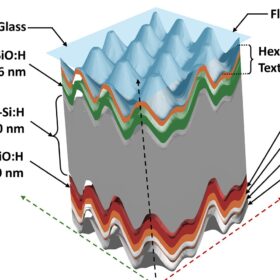
TU Delft researchers developed a novel hexagonal microtextured glass that enhances light scattering up to 50%, improving optical performance in thin-film silicon solar cells. The technology shows promise for multijunction, flexible, and low-power solar applications.
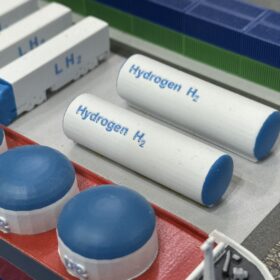
The Hydrogen Stream: Dutch agribusiness installs 1 MW electrolyzer
Dutch tulip nursery Rainbow Colors has completed the installation of a 1 MW solid oxide electrolyzer for on-site hydrogen production, while GlobalData says global low-carbon hydrogen capacity could reach up to 65.3 million tonnes per annum (mtpa) by 2030, driven largely by green hydrogen expansion in the Americas.
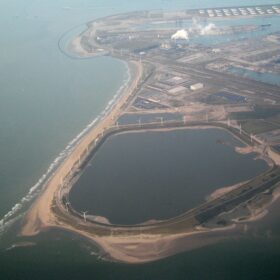
Rotterdam port advances 96 MW floating solar project for local use
A 96 MW floating PV project is set to be built at a dredging depot at the Port of Rotterdam. The array will not feed energy to the grid, instead serving local businesses. It is scheduled for operations in 2027.

The prospects for ultra-high-temperature heat pumps
An international research team has reviewed emerging solid-state and gas-cycle heat pumps capable of reaching temperatures of up to 1,600 K, assessing their challenges, applications, scalability, and technology readiness levels. The researchers say these systems could outperform conventional high-temperature heating technologies by achieving coefficients of performance above 1.
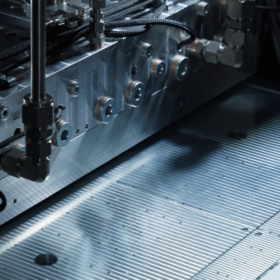
SALD launches large area sheet-to-sheet tool for perovskite solar pilot lines
The Dutch spatial atomic layer deposition equipment manufacturer has launched a new sheet-to-sheet tool for pilot production of large area perovskite solar devices on glass substrates.
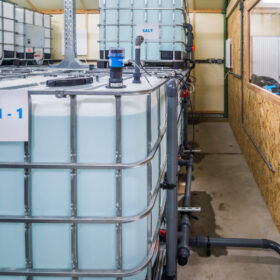
Long-duration storage as an antidote to grid congestion, renewables curtailment
RenewaFLEXNL, a three-year Dutch initiative led by TNO, aims to accelerate long‑duration energy storage (8–100 h) to reduce grid congestion and better integrate renewable energy. pv magazine spoke with the project coordinator, Iraxte Gonzalez Aparicio, about diverse storage technologies, real-world applications, regulatory guidance, and energy management system tools to support large-scale solar‑plus‑storage deployment in the Netherlands and beyond.
