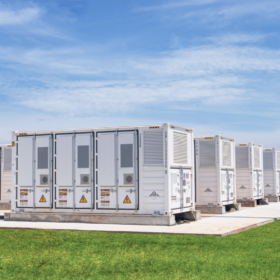
Brazil seeks Chinese investment ahead of first large-scale battery auction
Brazil’s Ministry of Mines and Energy is courting Chinese companies for its inaugural battery energy storage auction, which is expected to improve grid stability and renewable integration.

Singapore, China to supply solar-plus-storage power from Indonesia
Singapore’s Equator Renewables Asia (ERA) and China’s CRE International Co. Ltd (CREI) will jointly develop a 900 MW solar and 1.2 GWh battery project in Indonesia, with 400 MW (AC) slated for export to Singapore.
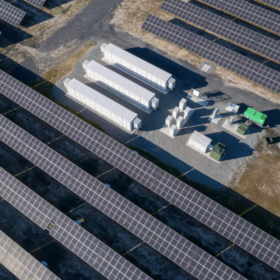
Spain provisionally awards €839 million to 11 GWh of energy storage projects
The Spanish energy agency has proposed funding for 144 energy storage sites totaling 2.61 GW and 11.14 GWh under a European Regional Development Fund program.

Foxconn launches Fox EnerStor brand to enter global energy storage market
Foxconn has launched its Fox EnerStor brand with residential, commercial and industrial (C&I), and utility-scale batteries. It aims to compete globally, with China and India as key hubs for R&D and manufacturing.

Europe moves to 15-minute electricity spot market, driving up battery revenue
The shift to 15-minute spot market intervals has increased battery arbitrage revenue in Europe, while providing more accurate signals for grid efficiency, says French battery storage specialist Storio Energy.
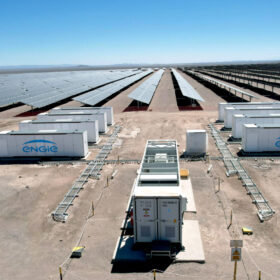
Hybrid PPA model improves PV-BESS bankability, say researchers
Researchers have modeled a hybrid financing scheme combining contracted and merchant components to improve the bankability of PV-battery energy storage system (PV-BESS) assets, using a Bayesian LSTM forecast integrated with a MILP optimization model to assess performance.

The Hydrogen Stream: Woodside nears completion of Beaumont ammonia project
Woodside Energy says its Beaumont New Ammonia Project is nearly complete, while Australia and India have agreed to collaborate on green hydrogen tech, supply chains, and workforce development.

Masdar, EWEC break ground on 1 GW baseload solar-plus-storage project
Abu Dhabi Future Energy Co. (Masdar) and Emirates Water and Electricity Co. (EWEC) have started building a solar-plus-storage project in Abu Dhabi that will deliver 1 GW of continuous baseload energy from a 5.2 GW solar plant paired with a 19 GWh battery system.
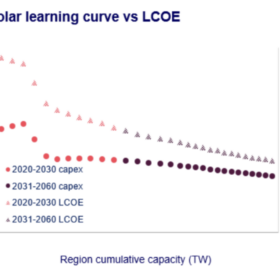
Wood Mackenzie records solar LCOE of $37/MWh in MENA region
Wood Mackenzie researchers say single-axis PV offers the lowest utility-scale generation costs globally, with efficiency gains and stable supply chains expected to drive down solar’s levelized cost of electricity (LCOE).
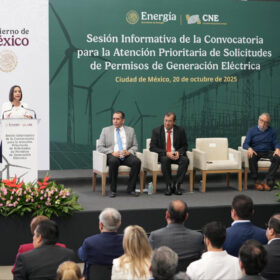
Mexico launches call to assign power generation permits
Mexico has opened a call for proposals for generation and interconnection permits to integrate new projects into the national electricity system under an accelerated evaluation mechanism aligned with binding planning.
