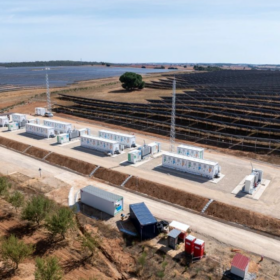
Iberdrola commissions Spain’s largest utility-scale battery systems
Iberdrola has commissioned Spain’s first utility-scale batteries at Alarcón, while Spain’s battery pipeline grows as major utilities develop new projects amid negative electricity prices.

Australian rooftop solar reaches record 4,407 MW output in Q4 2025
Rooftop solar generation reached 4,407 MW in Australia’s National Electricity Market (NEM) in the fourth quarter of 2025, contributing to peak renewable supply of 78.6% and reducing daytime operational demand.

Stäubli invests $10 million to expand PV connector manufacturing in India
Swiss connector manufacturer Stäubli invested $10 million to expand its manufacturing facility in Bengaluru to increase production of PV connectors for domestic and global solar markets.

New York City seeks $20 million from Radiant Solar over consumer fraud
The New York City Department of Consumer and Worker Protection has filed an administrative lawsuit against Radiant Solar alleging deceptive sales, fraudulent lending practices, and repeated code violations tied to residential solar installations.

Cyprus installs 122 MW of solar capacity in 2025
Self-consumption PV projects accounted for most of the new solar capacity added in Cyprus last year, despite record levels of renewable energy curtailment, according to industry data.
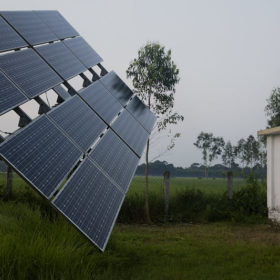
Bangladesh signs PPAs for 523 MW of solar capacity
The Bangladesh Power Development Board (BPDB) has signed power purchase agreements with seven solar projects totaling 523 MW, marking a renewed push for utility-scale solar following the reinstatement of previously canceled approvals.

EU installs 27.1 GWh of battery storage in 2025 as utility scale leads
The European Union added 27.1 GWh of battery energy storage capacity in 2025, with utility-scale systems accounting for the majority of new installations as residential storage declined amid lower electricity prices and reduced support schemes, according to a new report from SolarPower Europe.

Netherlands’ 2025 solar additions estimated at 2.08 GW
Provisional estimates from Dutch New Energy Research indicate the Netherlands added 0.54 GW of residential solar and 1.54 GW of C&I and large-scale solar last year, taking the country’s cumulative capacity to just shy of 30 GW.
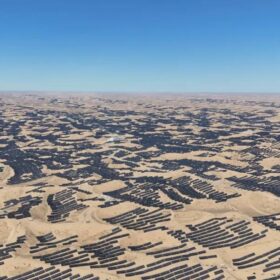
China adds 315 GW of solar in 2025
China installed a record 315 GW of new solar capacity in 2025, lifting cumulative installed PV capacity to 1.2 TW and pushing non-fossil power sources past thermal generation for the first time.
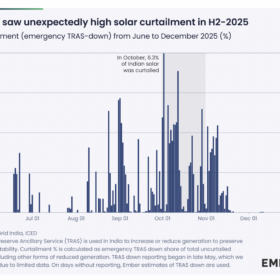
India curtails 2.3 TWh of solar between May and December 2025
A report by energy think tank Ember finds India’s system operator regularly had to curtail solar generation as an emergency measure to maintain grid security, as other resources were already flexing to their maximum capabilities.
