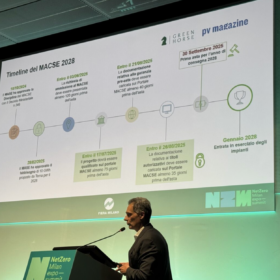
Will MACSE auction put Italy at the front of battery deployment?
Italy expects a wave of subsidized utility-scale batteries to meet all national grid needs, attendees heard last week at the NetZero Milan summit.
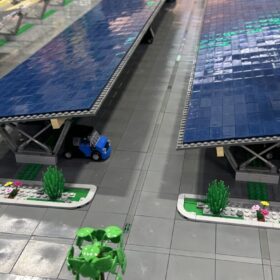
French parliament eases solar mandate for large parking lots
The French National Assembly has passed an amendment to ease rules on outdoor parking facilities, drawing protests from solar and renewable energy stakeholders who warn it undermines climate progress.

Jordan kicks off 200 MW solar tender
A tender in Jordan is seeking an independent power producer to develop a 200 MW solar project on a build-own-operate basis. The deadline to submit expressions of interest is July 15.

WoodMac tips Australia to fall short of 82% renewables goal
Wood Mackenzie predicts Australia will fall well short of its target of 82% renewable generation by 2030 due to grid connection delays, inadequate investment, and moves from some state governments to scale back their clean energy ambitions.

Site selection for PV plants on coal gangue hills
Scientists have developed a novel method to identify which hills of coal waste are suitable for the construction of a solar plant. Their technique integrates GIS and the technique for order preference by similarity to an ideal solution. They tested the new approach suburban areas of Yangquan City, China.

Chinese PV Industry Brief: Canadian Solar profit drops 92% in Q1
Canadian Solar says its net profit plunged nearly 92% in the first quarter of 2025 on falling margins, while China Energy Engineering Corp. (CEEC) says the Shanghai Stock Exchange has approved its targeted A-share issuance to raise up to CNY 15 billion (USD 2.09 billion) for energy projects.

‘There’s no need to mimic male counterparts or fit outdated stereotypes’
This week Women in Solar+ Europe gives voice to Christelle Mirailles, Business Development & Strategy at France’s Equans Solar & Storage. She says women should embrace their uniqueness rather than to conform to traditional leadership molds. “We should champion authenticity and individuality, viewing differences as strengths rather than liabilities,” she states.
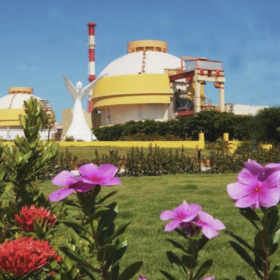
India plans 50 MW floating solar plant at nuclear site
Nuclear Power Corp. of India Ltd. (NPCIL) has approached Ciel & Terre to install a floating solar plant on a sea water dyke at the Kudankulam Nuclear Power Plant in Tamil Nadu, India.
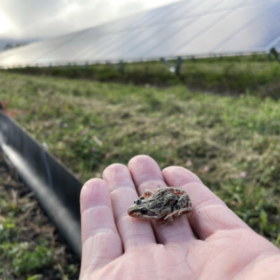
New biodiversity toolkit helps solar farm developers fast-track projects
Australia’s Thesium has launched a new product designed to help solar farm developers de-risk and accelerate their projects, which includes a credit feasibility analysis and board-ready stakeholder documentation.
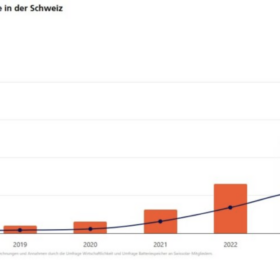
Rising demand for home solar storage in Switzerland
Trade group Swissolar has called for a national energy storage strategy to support the growing popularity of home solar-plus-battery systems in Switzerland.
