
Great British Energy doubles fund, commits $1.3 billion for manufacturing
Scotland, Wales and Northern Ireland to benefit from extra funding for community projects. Investment granted to fund renewable energy schemes and solar panels on public sector buildings.

Eternal Sun offers solar simulators for space PV testing
A new optional light emitting diode (LED) board pre-calibrated for AM0 testing is available for the company’s flagship LED solar simulators.

AX Solar Robot showcases cleaning system for C&I solar
The French PV cleaning specialist has aunched a fully autonomous cleaning system for steep commercial and industrial PV roofs, designed for frequent cleaning in dusty environments.
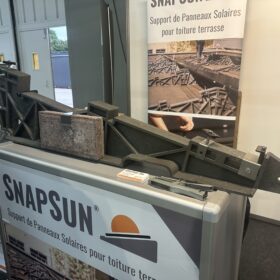
Snapsun introduces rooftop mounting system made of recycled plastic
The French mounting system provider offers an 8 kg rooftop PV system made from recycled plastic. The system reportedly simplifies installation and reduces strain, with integrated cable guides and clip-on connectors that support panels up to 1,180 mm.

DMEGC launches framed solar module weighing 7.5 kg/m2
In response to the growing demand for solutions for low load-bearing roofs, Chinese manufacturer DMEGC is presenting an IEC-certified lightweight 460 W module at France’s largest PV trade show – EnerGaïa.
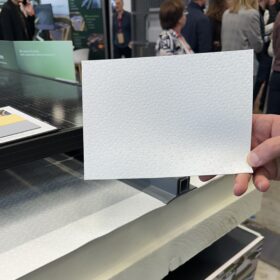
Renolit showcases reflecting cool roof membrane for bifacial rooftop PV
Renolit France has introduced the Alkor Bright reflective membrane for bifacial rooftop PV systems, offering high solar reflectivity and durability for flat or pitched roofs. The membrane helps keep buildings cooler while boosting the energy output of bifacial solar modules.
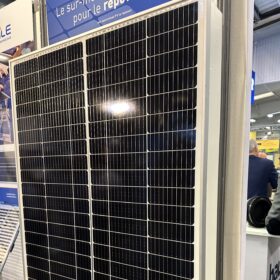
France’s S’tile offers custom PV modules for repowering, revamping
S’tile has launched fully customized solar modules for repowering and revamping rooftop PV systems, providing exact-fit replacements or higher-output upgrades tailored to each project.

Solar budget of up to $180 million in next UK CfD auction
Seventh allocation round (AR7) budget for onshore technologies assigned by the government, with enough cash for solar to support 4 GW of capacity. Success for solar at the next two contracts for difference (CfD) seen as key to achieving UK government’s 2030 clean power targets.
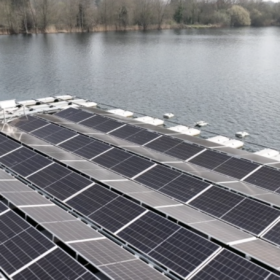
Ciel & Terre unveils new floating solar solution
The new floating PV structure removes traditional maintenance walkways between module rows to enable more solar modules to be installed per hectare. Ciel & Terre has also developed a motorized trolley system capable of rolling over the structure.
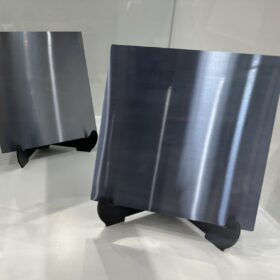
Sunwafe secures land for 20 GW silicon wafer plant in Spain
Sunwafe says it has formally applied to reserve land in Asturias, Spain, for a 20 GW silicon wafer and ingot factory backed by Chinese capital, EIT InnoEnergy, and a €200 million ($232.6 million) Spanish government grant.
