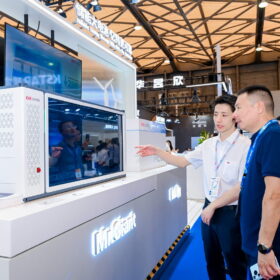
EVE showcases 836 kWh split-unit storage, eyes overseas expansion
The Chinese manufacturer debuted split-unit 836 kWh system at SNEC ES+ 2025, targeting flexible, safe overseas commercial deployments.
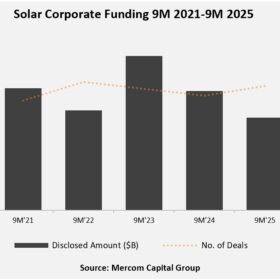
Solar sector corporate funding falls 22% year-over-year
Venture capital, public market, and debt financing into the solar industry reached $17.3 billion through the first 9 months of 2025, said Mercom Capital Group.

Elecnova releases 1 MW/2 MWh ESS for grid-scale use
The Chinese company says its new product is available in a standard container configuration. Its liquid and forced-air cooling systems reportedly maintain a cell temperature difference of just 3 C

Key takeaways from SNEC ES+ 2025 in Shanghai
A smaller-than-expected trade show underscored mounting exhibitor fatigue, even as high-integration and safety-focused storage products showcased where the industry is heading.

France adds 4.2 GW of solar in first nine months of 2025
Statistics from Enedis show that 4.2 GW of solar connected to France’s grid in the January-September period, including 82 MW paired with storage, marking a slight decline from 2024.

Future-proof or fail: how battery storage projects can thrive in Germany
Germany’s battery storage boom is real but so are the bottlenecks. As capital pours in and gigawatt-hour-scale projects near launch, grid connection delays and regulatory uncertainty are threatening to dampen momentum. At the 3rd BVES Investor Summit in Berlin, more than 500 industry leaders gathered to weigh the hype against the hard realities.

Unlimited low-cost energy storage
In its latest monthly for pv magazine, the International Solar Energy Society (ISES) explains how pumped-hydro energy storage combined with PV power generation could provide 24/7 power to data centres

Alsym Energy launches sodium-ion battery line
The Massachusetts-based startup says its new battery is non-flammable, non-toxic, and uses non-FEOC (Foreign Entity of Concern) materials, aiming for a lower levelized cost of storage (LCOS). The technical specs provide some highlights as well.
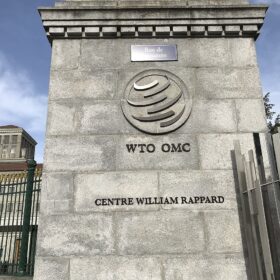
What WTO can still do to regulate global cleantech trade
pv magazine spoke with energy and environmental law expert Anatole Boute about the past and future role of the World Trade Organization (WTO) in regulating trade disputes related to clean energy technologies amid current geopolitical tensions. He noted that despite recent protectionist efforts to revive the solar manufacturing industry, the European Union still strives to remain compliant with WTO rules.
Optimizing solar-plus-storage operation for markets with imbalance penalties
Scientists in Japan have used a deep reinforcement learning–based AI model to calculate discrepancies between the planned and actual electricity supply volumes in PV-battery systems operating in markets where grid imbalances are penalized. Through a series of simulations, they found that the proposed methodology can reduce imbalance penalties by approximately 47%.
