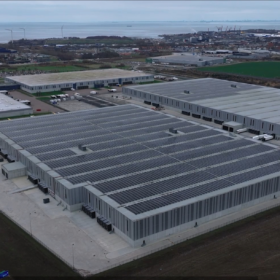
Scandinavia’s largest rooftop PV plant goes online
Scandinavia’s largest rooftop PV plant, a 14 MW array in Landskrona, Sweden, has gone online. The system, consisting of 24,000 JinkoSolar modules, was installed on a warehouse roof by Danish transport company DSV.
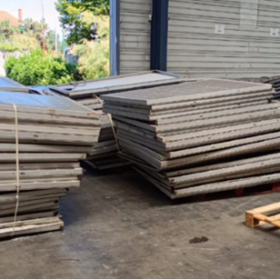
European consortium reuses second life PV panels, EV batteries in agrivoltaics, plug-in solar, low-budget projects
A European team is developing technologies and processes to show how end of life PV panels and electric vehicle (EV) batteries can be used in three distributed energy market segments: agrivoltaics, plug-in PV for households, and low-budget solutions. It will also demonstrate efficient recycling processes for critical raw materials recovered from panels and batteries that cannot be reused.

Spain’s rooftop PV installations hit 1.18 GW in 2024
UNEF, Spain’s PV association, says developers installed 674 MW of industrial PV in 2024, alongside 207 MW in the commercial sector and 275 MW of residential solar installations.

Roofit.Solar releases new BIPV panels with narrow roof coverage
Estonia’s Roofit.Solar has developed new building-integrated photovoltaic (BIPV) panels with an effective width of 470 mm, offering power outputs of 120 W or 180 W.
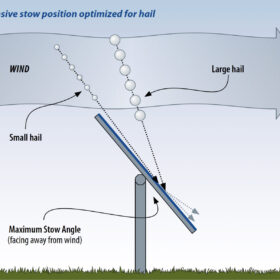
Actionable insights to safeguard solar projects from hail damage
The second article in a two-part series from VDE Americas looks at hail risk mitigation measures that continue advancing through improved materials, prediction capabilities and refined stow strategies.
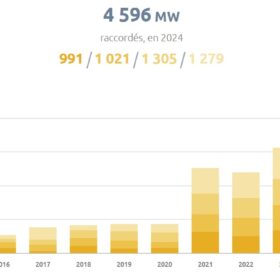
France deploys 4.6 GW of PV in 2024
France deployed 4.6 GW of solar in 2024, bringing its total PV capacity to 22.12 GW. Grid operator Enedis says that self-consumption accounted for 35% of new installations.
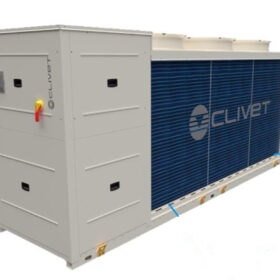
Clivet launches new air-source heat pumps for commercial buildings
The Italian manufacturer said its new Large Evo PL heat pump can achieve a seasonal coefficient of performance of up to 4.17. The system can also reportedly deliver water temperature of up to 60 C and, when stacked in series, reach a maximum system capacity of 1,660 kW.
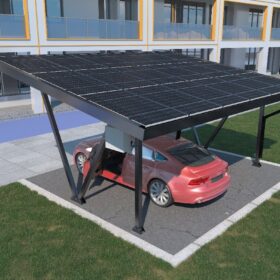
Mibet launches waterproof solar carport
The Chinese company said that its new product has a drainage edge that ensures complete waterproofing. It can purportedly withstand wind speeds of 45 m/s and a snow load of 1 KN/m².
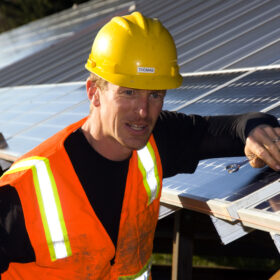
US state attorneys general urge Congress to keep IRA clean energy credits
Seventeen US state attorneys general have urged Congress to retain clean energy tax credits, citing the Inflation Reduction Act’s (IRA) “catalytic” effect on economic growth, especially in Republican districts.

The best residential PV system configuration for Saudi Arabia
Researchers in Saudi Arabia have identified the best and optimum PV system configurations for the Saudi residential market. Their analysis investigated the capacity threshold that leads to a lower cost of electricity compared to grid electricity costs. They used NREL’s HOMER software to analyze the energy requirements of the residential units, the solar energy potential and weather characteristics of the selected location, and the financial parameters influencing a project’s profitability.
